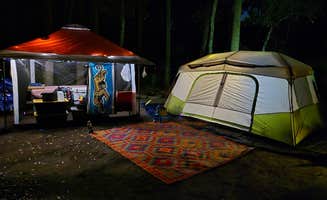
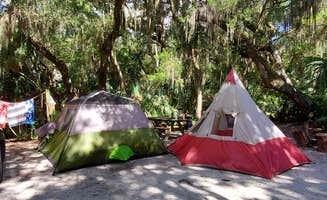
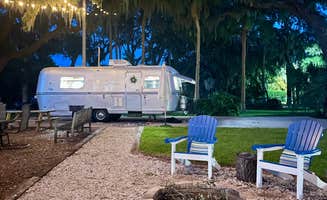
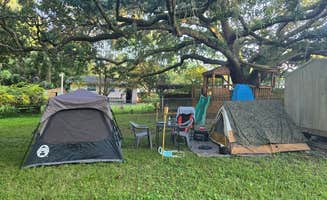
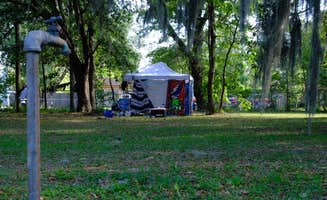
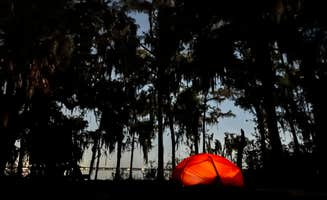
Nestled within the longleaf pine flatwoods of Matanzas State Forest just south of St. Augustine, the group campground here feels like stepping into a slice of Old Florida: untamed, tranquil and blissfully simple. Managed by the Florida Forest Service, this rustic site lies within the Pellicer Creek Corridor, where the air is thick with pine and salt, and the forest floor hums with life. The drive-in sets the tone where a canopy of oaks shrouded with Spanish moss gives way to open meadows and whispering wetlands before revealing the group camping area, which I must admit, is NOT the easiest place to find, but once you do, you’ll discover a wide, sandy clearing ideal for tents, both large and small as well as, of course, hammocks, which are perfect to absorb the shade that this space offers.
So, insofar as getting to this location is concerned, basically, once you enter Matanzas SF on Double Gate Road from US1, you’ll essentially drive east until you have the opportunity to drive north before you wind up in the NE corner of the forest. There’s a lot of possible pathways you could take that will get you lost, but basically, you would have to be driving down non-cleared roads that have signs indicating you can’t drive on these pathways anyway. Your GPS will work out here and I would suggest you follow the roads on TheDyrt mobile app to guide you to this location as it is spot on. But when you do arrive, you’ll discover a simple parking lot with about 4 different pathways leading in opposing directions – so which one to take? That’s the greatest question you’ll find yourself asking. Here’s what you want to do – just stay in your car and keep driving north down the path that has tire marks on it and within 50 yards, it will drop you off at the Group Campground.
Facilities are modest but well-kept: there’s an oversized fire ring with foldable grill as well as single oversized, double-sided stand-up BBQ grill, about a half dozen picnic tables (with half being delapidated and the other half brand spanking new), a single port-a-potty and no potable water or source of electricity. What this spot lacks in amenities though makes up for in serenity. This is the kind of place where your morning alarm is a woodpecker’s knock and your evening entertainment is a campfire under a sky thick with stars. The surrounding trails and forest roads connect to the Pellicer Creek Aquatic Preserve and the Graham Swamp Trail System, offering plenty of opportunities for hiking, biking, paddling and spotting wildlife like egrets, deer, and the occasional wild turkey.
Although secluded, the campground is only about 20 minutes from Ancient City and 10 minutes from Palm Coast, making supply runs and day trips easy. For essentials, stop by the Publix Super Market on Palm Coast Parkway, the Shell gas station at US-1 and Old Kings Road, or the nearby Tractor Supply for ice and camping odds and ends. There’s no REI or Bass Pro Shop within 10 miles, but Academy Sports+ Outdoors is the best bet for outdoor gear and fishing tackle, although that's going to be a hike (er, long drive) from here.
Insider’s tips? Here’s a handful: (1) The group site’s best tent placement is on the southern edge of the clearing where the pines provide late-day shade and natural wind protection; (2) Bring plenty of water as there’s no potable water here; (3) For kayaking or canoeing, head to the Pellicer Creek launch on nearby Old Kings Road for calm water and beautiful tidal scenery; (4) Trails in Matanzas can flood after heavy rain, so check conditions with the Forest Service before arriving; (5) Wildlife lovers should keep an eye out for gopher tortoises along the sandy roads and hawks circling above the pine canopy – on our visit, we were blessed to see an adolescent black panther; and (6) When it’s time to eat, reward yourself with a laid-back bite of a Surfin’ Cali burrito at nearby Jimmy Hula’s or an elegant dinner of steak pom frites at Le Bouchon Brasserie in the historic district of the country’s oldest city.
Happy Camping!












 Guide
Guide


