Many RVs, trailers, and “power packages” promise some version of getting you “up to X days off-grid.” Sounds great. But dig a little deeper and you’ll quickly realize those numbers don’t mean much without knowing what assumptions are baked in.
Real off-grid duration isn’t a fixed number. It shifts based on how you actually camp. Run the air conditioning on a scorching day in Death Valley. Make coffee every morning. Keep the refrigerator cold. Run Starlink for a few hours. Each of those decisions chips away at your battery. And how much you can produce varies widely too. But that’s complicated, so most manufacturers just simplify estimates.
The good news is that off-grid time doesn’t have to be a vague marketing estimate. You can calculate realistic limits based on how you actually camp.
Why Off-Grid Capability Isn’t One-Size-Fits-All
Off-grid duration is basically a budgeting problem: you start with a certain amount of stored resources, you consume some of those resources each day, and you may (or may not) regenerate some resources depending on your setup and conditions.
Here are the variables that matter most:
- Battery capacity (energy storage): How much energy you can store, typically expressed in kilowatt-hours (kWh).
- Power generation: Most commonly solar, but in some setups, an integrated or portable generator can also recharge a battery system.
- Appliance and device usage: Especially high-draw loads like air conditioning, space heating, and electric cooking.
- Climate, season, and weather: Heat/cold changes HVAC demand, and clouds change solar harvest (even with the same panels).
- Cooking habits: Whether you cook full meals and what appliances you use affects both kWh and gallons.
- Water usage: Showers, dishes, and toilet use can become the limiting factor, even if you have plenty of power.
- Daily routines and lifestyle: Remote work (internet gear + laptop power) vs. occasional electronics use can vary your consumption widely.
In other words, a minimalist weekend camper charging a phone and running lights is solving a totally different problem than a comfort-focused boondocker running HVAC, taking hot showers, cooking real meals, and staying connected for work.
Most Campers Are Still Guessing
Part of why off-grid claims are so confusing is that marketing often compresses a complicated electrical reality into a single number. And many campers understandably mix up power and energy. Here’s the difference between the two:
- kW (kilowatts) is how fast you’re using (or producing) electricity (think speed).
- kWh (kilowatt-hours) is how much electricity you use over time (think distance traveled).
That’s why an inverter’s “12 kW output” (how much power it can deliver at once) is a different question than a battery’s “43 kWh capacity” (how much energy it can store).
For context, the U.S. Energy Information Administration estimates the average U.S. household uses about 29 kWh per day (of course, homes also vary a lot in their energy usage).
Portable generators add another layer of confusion. They can power appliances while running, but they don’t store energy. Once they’re off, so is your power. That’s a fundamentally different setup than an integrated battery system, and the two aren’t interchangeable for off-grid planning purposes.

The Tool That Calculates Your Real Off-Grid Duration
If you want to replace guesswork with a clearer model, the Evotrex Off-Grid Calculator is designed to do exactly that: you enter lifestyle and trip variables, and it estimates your power usage (kWh), water usage (gallons), and your estimated off-grid duration.
What you can input (and the units it uses)
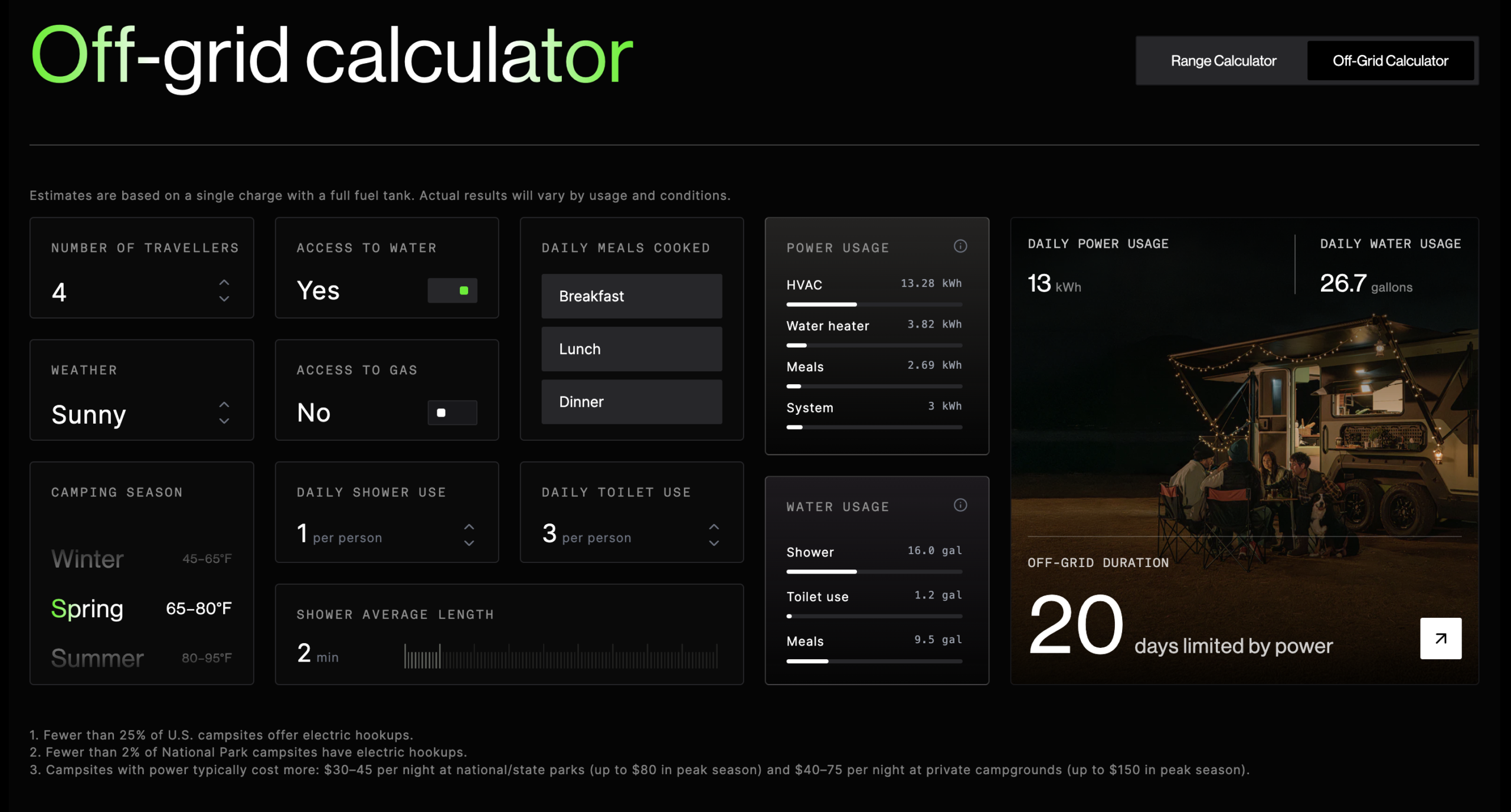
The Off-Grid RV Calculator interface includes inputs such as number of travelers, camping season (shown with temperature ranges in °F), weather (e.g., sunny/cloudy), whether you have access to water and access to gas, plus daily routine inputs like showers (including average length in minutes), meals cooked, and toilet use. Each variable has an information icon that walks you through each element of the formula.
What you get out
The calculator displays an estimated off-grid duration and breaks out power usage in kWh (with categories like HVAC, water heating, meals, and system loads) and water usage in gallons (with categories like shower, toilet use, and meals).
Why the transparency matters
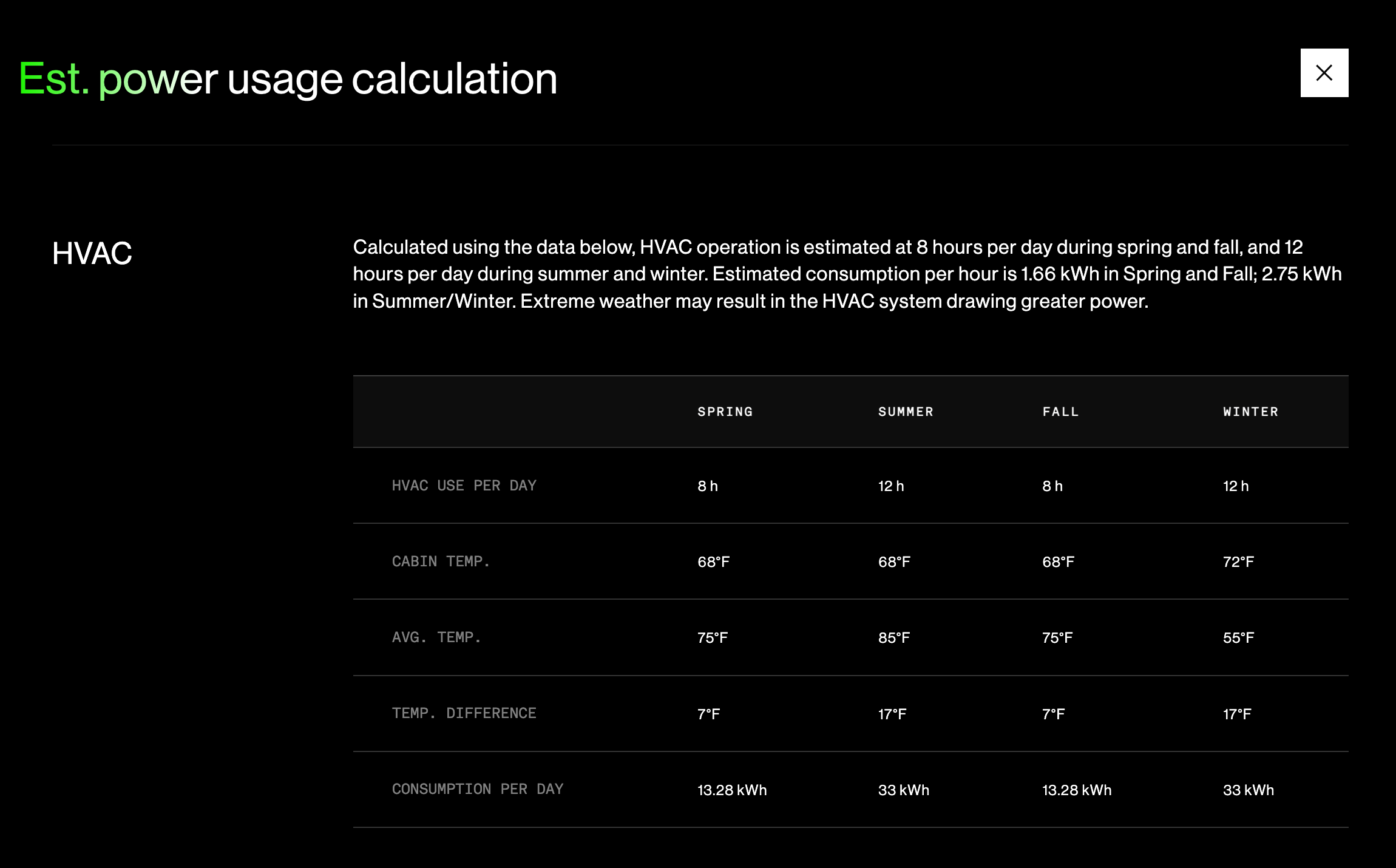
Evotrex also publishes a detailed “Estimated Power Usage Calculation” page that shows the model’s core assumptions, like HVAC hours per day by season, per-hour HVAC consumption, assumed hot shower temperature, and a weather-based solar generation offset tied to “peak sun hours.”
Ready to run your own scenario? Try the Evotrex Off-Grid Calculator
Not All Power Systems Are Created Equal
For years, bringing a generator often meant hauling a portable unit, running extension cords, planning around noise, and treating power as a separate system you bolt onto camping.
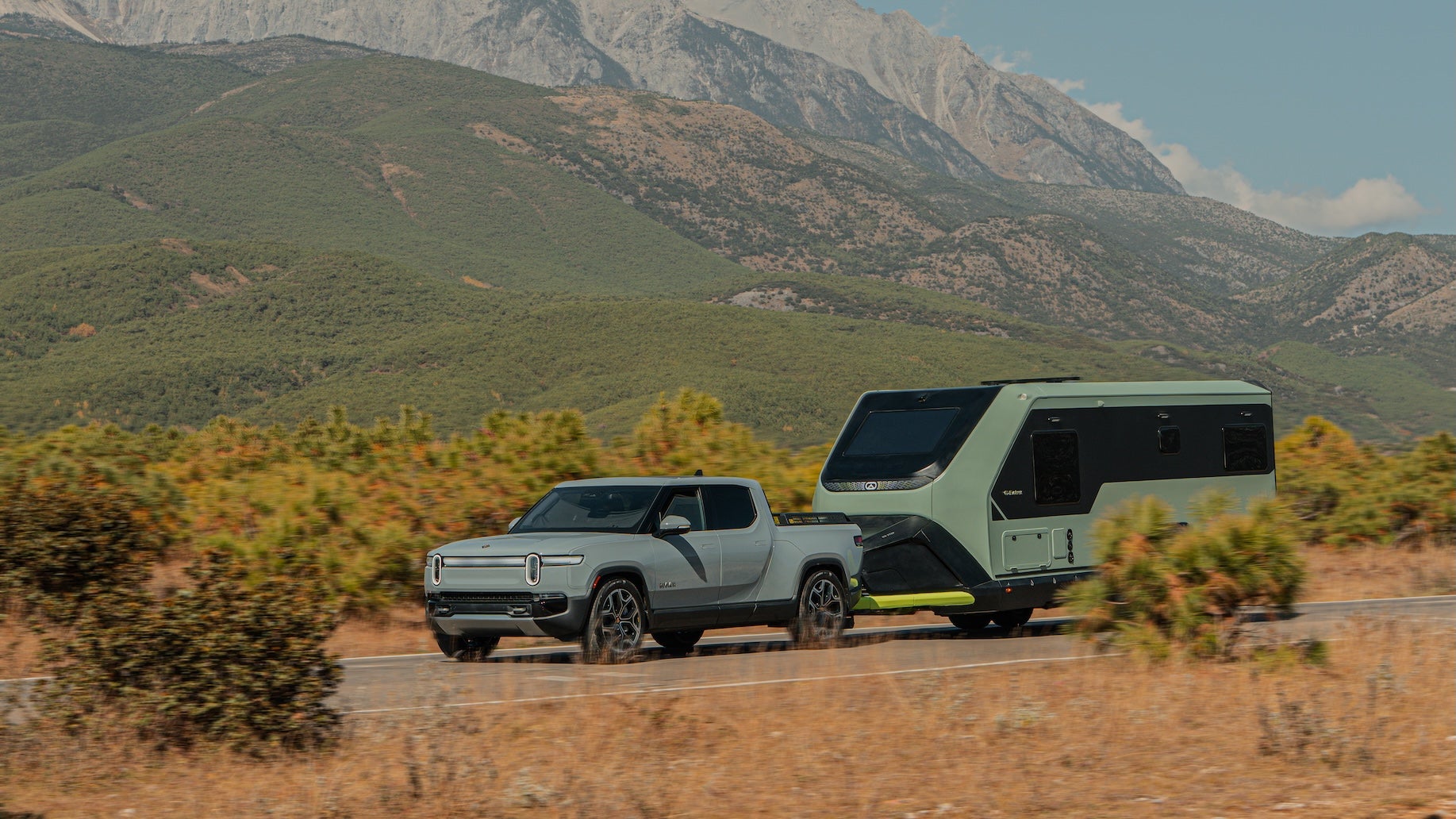
Modern off-grid systems, like the Evotrex Horizon™, can be more integrated. They’re designed to generate, store, and manage energy as a single ecosystem, so your off-grid plan looks more like “energy budgeting” than “generator logistics.”
This is worth understanding before you start adjusting numbers in any calculator. Traditional portable generators and modern integrated battery systems work very differently. Let’s compare:
| Traditional Portable Generator | Horizon™ Integrated System |
| Must run continuously to power appliances | Generator activates only when needed |
| Loud and fuel-dependent | Silent battery operation for daily use |
| Often limited in output | Up to 75 kW rated output |
| Manual setup required | No setup required |
| Separate from RV power system | Fully integrated into the RV |
| Recharges 43 kWh battery in ~2 hours when parked | |
| Less than an hour to recharge while towing | |
| Controlled via onboard tablet | |
| Automotive grade |
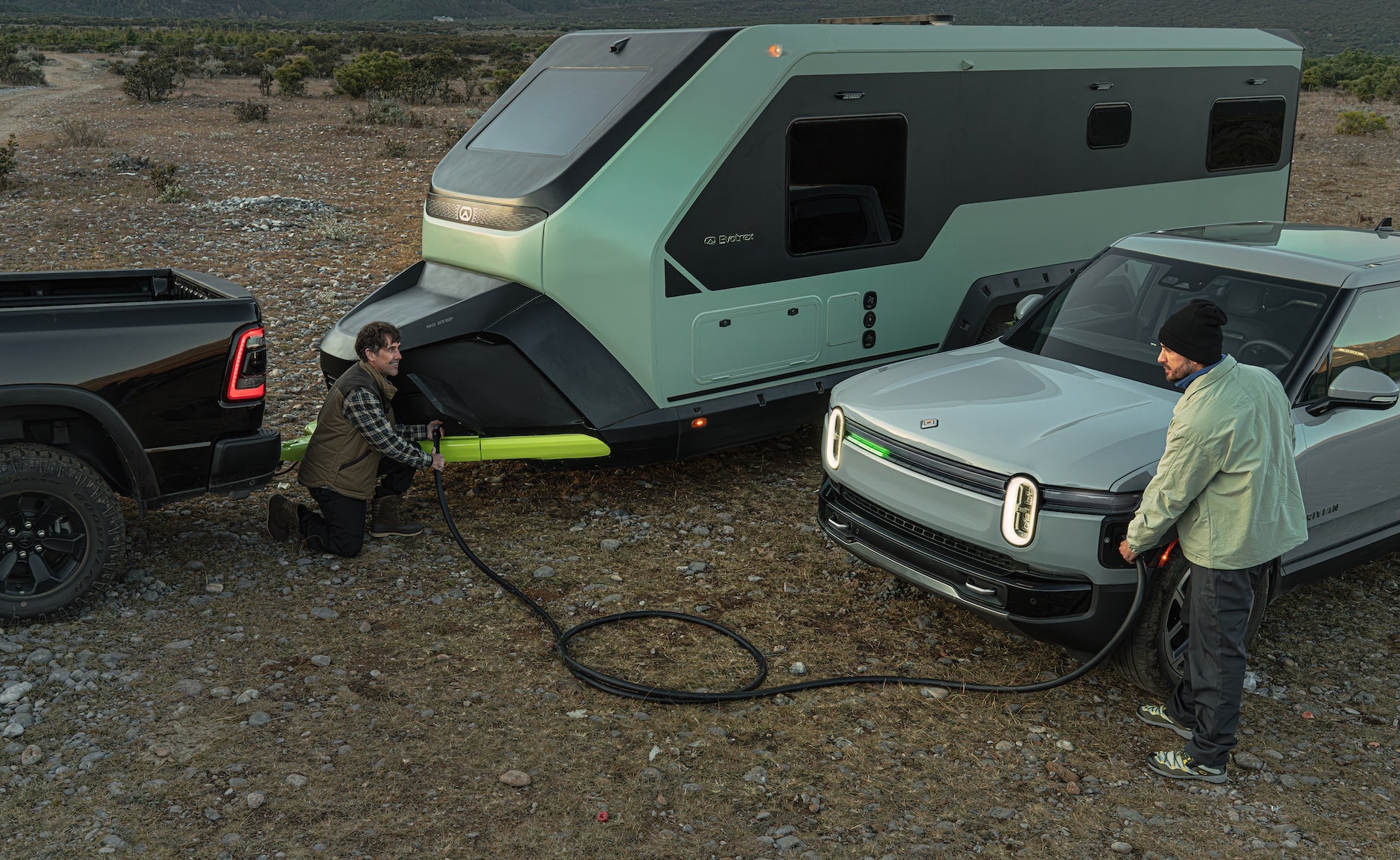
Another cool feature of the Horizon™ integrated system is that it enables vehicle-to-vehicle fast charging. This is a first in the RV industry, and it means that you can fast charge, at up to 60 kW, your or your friends’ EVs anywhere, so they can join you and camp in places where DC fast chargers aren’t available yet.
Why This Matters for Campers Who Want True Freedom
Experienced campers already know that the best spots (like dispersed BLM land, remote national forest sites, the places worth driving an hour of dirt road to reach) require genuine self-sufficiency. Not a vague promise of it.
Knowing your real energy limits means staying longer. It means not cutting a trip short because you miscalculated, and not running a noisy generator at 8pm because you didn’t plan for the extra day. It means accessing the campsites that require actual confidence in your system.
That’s the real value of modeling (and not guessing). You can match your trip style to your resources, pick a camping plan with confidence, and avoid building your whole itinerary around a pedestal.
The calculator is one-half of that equation. Having a system capable of supporting your habits is the other.

Beyond Marketing Claims: Off-Grid Capability Becomes Predictable
The RV world is shifting: more rigs are leaning into battery-based systems, solar is becoming more common, and energy is turning into a primary planning variable.
What makes tools like the Off-Grid RV Calculator feel like a step forward is the transparency: inputs you can adjust, outputs you can interpret, and core assumptions you can challenge (seasonal HVAC loads, solar “peak sun hours,” and daily-use estimates).
Test Your Own Setup
If you’ve ever wondered “Can we run the A/C?” or “How long will our tanks last?” this is the fastest way to get a defensible, scenario-specific answer. Run it as a minimalist, then start adding comforts, like showers, more complex meals, devices, and heat or A/C. Then play with the uncontrollable things, like sunny vs. cloudy conditions.
Off-Grid Camping Shouldn’t Be a Guessing Game
When you model off-grid capability based on real behavior, and you can see the assumptions behind the math, you get the info you need to camp confidently. Once you know what your days actually cost in kWh and gallons, you can roam farther, stay longer, and camp with fewer compromises.
CTA: Ready to run your own scenario? Try the Evotrex Off-Grid Calculator.
Built Around That Freedom: Meet the Evotrex-PG5
If the calculator gives you a picture of what your off-grid life could look like, the Evotrex-PG5 is the rig built to support it. The PG5 runs on 270 kWh of usable energy on demand, with two residential queen beds, full climate control, and a smart-home living setup, without cutting corners on build quality. The chassis is automotive-grade, sitting on 33″ all-terrain tires with air suspension, so the remote sites that actually require that kind of range are genuinely within reach.
It’s designed to go farther, stay longer, and keep you comfortable the whole time. Pre-orders are open now with a $100 fully refundable deposit, and Evotrex expects to start shipping in early 2027. Reserve yours here.
The Dyrt is the only camping app with all of the public and private campgrounds, RV parks, and free camping locations in the United States. Download now for iOS and Android.Popular Articles:
Articles on The Dyrt Magazine may contain links to affiliate websites. The Dyrt receives an affiliate commission for any purchases made by using such links at no additional cost to you the consumer.