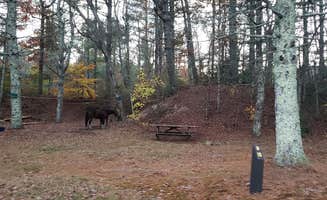
LeGrand Reynolds Horsemen's Camping Area offers equestrian-friendly sites in Arcadia Management Area, which spans over 14,000 acres at elevations between 250-450 feet. The camping area features basic facilities for riders who bring their own horses, with trail access directly from the campground. Water sources can be limited during drier summer months, so campers should plan accordingly.
What to do
Horseback riding on extensive trail systems: At Frog Hollow Horse Camp at Pachaug State Forest, riders have access to three horseback riding loops that leave directly from the campground. "Campsites are located around a loop with a couple of composting toilets near the entrance. Water is available. There's space for your camping gear as well as a trailer and horseline," notes Jean C.
Swimming in natural ponds: Charge Pond Campground provides access to multiple kettle ponds for summer recreation. As Kim R. explains, "We also enjoyed the various kettle ponds. We kayaked one morning and enjoyed watching the people catching good sized fish around us. The beach (at least at Charged Pond) had a nice sandy section and a bathhouse."
Hiking through diverse terrain: Trails throughout horse campgrounds near Greenville, Rhode Island offer varied terrain for all skill levels. At Mashamoquet Brook State Park, visitors find "a small walking path and a larger intermediate hiking trail" according to reviewer 175 P., who adds that there are "large open areas for kids and adults to play during day and star gaze at night."
What campers like
Privacy between sites: Many equestrian campgrounds provide good separation between camping areas. At Wolf Den Campground, Gary G. found "most sites are relatively short level pads, with little or no shade, but very pleasant. We picked site 33 for the best shade and longer pad." This campground also features "no road noise" and can be "totally silent" on weekdays.
Natural water features: Ponds and streams near equestrian camping areas provide recreation options beyond riding. At Ponkapoag Camp, Gordon C. reports "water was nice and fish were biting," while Rita M. notes "the pond itself is a wonderful place for kayaking and canoeing. There are several rocky boulders poking out of the water that make fun spots to discover."
Rustic camping experience: Horse campgrounds typically offer basic amenities focused on equestrian needs. Ponkapoag Camp provides a back-to-basics experience where "kids can hang out in the clubhouse if it's raining or swim in the pond if it's hot," according to stacy, who appreciates that "it is rustic camping, no water or electricity and the bathroom is an outhouse and no showers."
What you should know
Campground reservation systems vary: Some equestrian campgrounds require advance planning while others operate first-come, first-served. At Frog Hollow Horse Camp, Jean C. notes it's a "first come, first serve campground" with limited information available online. Call ahead to confirm availability and requirements.
Seasonal constraints: Most horse-friendly campgrounds have weather-dependent conditions. Normandy Farms Campground, though not exclusively for horses, operates from "Apr 1 - Nov 30" according to their listing, which helps understand the regional camping season.
Limited amenities: Horse camping focuses on functional needs rather than comfort. When setting up at equestrian sites, expect basic facilities. At Mashamoquet Brook State Park, Gary G. found the campground "totally cleaned up from any damage or debris, all in great shape" even after a hurricane, showing the maintenance priorities focus on functionality.
Tips for camping with families
Bring entertainment options: Children may need activities beyond riding. At Myles Standish State Forest, Katie D. recommends the campground for families because it offers "swimming, fishing, camping, hiking, trails, boating and more." She notes "forest staff are so nice, extremely helpful, and take any issues seriously."
Choose campgrounds with accessible water features: Ponds provide alternative recreation for non-riders. At Myles Standish, Stephanie B. shares that "We stay at Myles Standish every June. We stay in the charge pond area which is a smaller pond but nice and clean. There are bbqs, tables and bathrooms at the pond."
Look for campgrounds with designated play areas: Some facilities offer specific recreation spaces for children. At Mashamoquet Brook State Park, 175 P. appreciated the family-friendly layout: "Very nice sized lots. Large open areas for kids and adults to play during day and star gaze at night."
Tips from RVers
Verify site dimensions for trailers: Horse trailers require adequate space at campsites. The The Preserve Club and Residences offers diverse accommodation types including RV sites, with Chris M. calling it "New England's most amenity rich properties" with a "diverse amount of outdoor offerings."
Plan for electric needs: Equestrian campsites may offer limited electrical hookups. At LeGrand Reynolds Horsemen's Camping Area, 30-amp and 50-amp electrical connections are available for campers who need power while managing horses, though these amenities aren't common at all horse campgrounds in the region.
Research water availability: Many horse campgrounds have limited water access. Jean C. notes that at Frog Hollow Horse Camp, "water is available" but doesn't specify if it's suitable for horses, so planning water supplies for animals remains important when visiting equestrian camping areas near Greenville, Rhode Island.




 Legend


