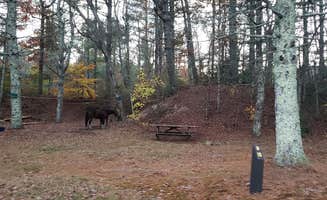
Pachaug State Forest provides equestrian camping facilities in the rural eastern Connecticut woodlands near the Rhode Island border. The forest spans over 24,000 acres across several towns including Griswold and Voluntown, with varied terrain of mixed hardwood forests, wetlands, and rocky outcroppings. Camping options range from designated horse camps to standard tent sites, with most facilities operating seasonally from spring through fall when temperatures average between 45-85°F.
What to do
Trail riding on forest paths: Frog Hollow Horse Camp provides direct access to three riding loops that connect to a larger network of forest trails. According to Jean C., "Three horseback riding loops leave from the campground. There's also fishing and hiking available in the forest."
Fishing in nearby ponds: Wolf Den Campground at Mashamoquet Brook State Park offers fishing opportunities. Gary G. notes, "The park was completely cleaned up from any damage or debris, all in great shape... Most sites are relatively short level pads, with little or no shade, but very pleasant."
Geocaching adventures: Several caches are hidden throughout Pachaug State Forest. "There's a small playground in the middle of the loop, a number of hiking trails throughout the park along with a few geocaches (download details for offline use as phone connection is spotty)," states one camper about nearby areas.
Star gazing from open meadows: Look for clearings in the forest or camp in more open sites. One camper at a nearby park mentions, "Large open areas for kids and adults to play during day and star gaze at night."
Historical site exploration: Visit the old mill and blacksmith shop at Mashamoquet Brook. "A small brook with an old mill and blacksmith shop that is sometimes open on weekends for tours. It's a nice place to explore and have a picnic," shares Jean C.
What campers like
Peaceful forest setting: Most equestrian sites offer natural surroundings with moderate privacy. A visitor to The Preserve Club and Residences noted, "It may be the only place in the world that has such a diverse amount of outdoor offerings."
Uncrowded camping experience: Even during peak season, horse camps rarely reach full capacity. Many riders appreciate the lower traffic compared to standard campgrounds, especially mid-week.
Direct trail access: Equestrians value not having to trailer horses to trail access points. The LeGrand Reynolds Horsemen's Camping Area in nearby Rhode Island offers similar convenience with electric hookups for horse trailers.
Basic but functional amenities: Sites typically include necessary horse facilities without resort frills. At Wolf Den Campground, one camper noted, "The parking pads are paved and a few have overhanging branches, but the trees provide separation and some shade on largely open sites that tend to open up toward the back with open areas for pitching tents."
Natural shade coverage: Many sites feature tree coverage that helps keep horses and camping areas cooler during summer months. "We picked site 33 for the best shade and longer pad," shares Gary G. about his experience at a nearby campground.
What you should know
Seasonal water availability: Some horse campgrounds shut off water during freezing months. Check with forest headquarters before arriving in colder weather to confirm availability.
Limited cell service: Most forest campgrounds have spotty or no cellular coverage. One camper advises, "Download details for offline use as phone connection is spotty."
Reservation systems vary: While some campgrounds like Normandy Farms Campground use reservation systems, horse camps often operate on first-come, first-served basis, particularly during shoulder seasons.
Trail conditions change seasonally: Spring often brings muddy conditions while summer drought can create hard, dusty trails. Call ahead for current trail status.
Varying campsite sizes: Site dimensions accommodate different rig sizes. "Sites have fire rings with grills and picnic tables. Site 20 is the only one with electric. The ones toward the back of the loop back up toward the woods and give you some more privacy," notes one camper about a nearby park.
Tips for camping with families
Pack extra water containers: Horse campgrounds typically have limited water spigots, so bringing additional storage helps. A visitor to a nearby site mentioned, "Most sites are relatively short level pads, with little or no shade, but very pleasant."
Bring insect protection: The wooded areas around Griswold can have significant mosquito activity, especially in spring and early summer. One camper at Normandy Farms Family Camping Resort shared that even at more developed campgrounds, "It's super easy to get around. They had tons of festive activities."
Plan for composting toilets: Most horse camps use composting or vault toilets rather than flush facilities. Families with young children should prepare accordingly.
Bring games and activities: Unlike resort campgrounds, horse camps have minimal organized activities. "We stayed here for a few nights when they celebrated Halloween. It is super easy to get around. They had tons of festive activities," noted one camper about a family-friendly alternative.
Check pet policies: While many horse camps allow dogs, specific rules about leashing and trail access vary. "They have a huge off-leash dog park which has a dog washing station, water fountains for dogs and humans, agility-type obstacles for them to play on," shared a camper about more developed alternatives in the region.
Tips from RVers
Level before unhitching: Many horse camp sites have natural, unpaved surfaces that may require additional leveling. "The site was level. At the time we were there in October the campground was not very busy," noted one RVer about a campsite in the region.
Plan for electrical limitations: Horse camps typically offer minimal or no hookups, so arrive with fully charged batteries and consider portable solar panels or generators where allowed.
Arrive with fresh water: Tank fill options can be limited at more primitive campgrounds. Bring water especially if traveling with horses.
Reserve early for larger rigs: Limited large sites fill quickly in peak season. "Our site was easy to navigate in and out of and was definitely big rig-friendly with ample space for our motorhome and tow car. All utilities were well-placed and functioned properly," shared one RVer about camping options in the region.
Prepare for tighter access roads: Forest roads leading to horse camps can be narrower than standard RV parks. Some campers note that "Roads are paved and plenty wide enough for big RV's to navigate" at more developed campgrounds, but forest service roads are typically more primitive.




 Legend


