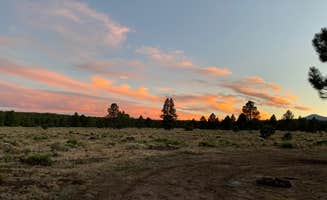
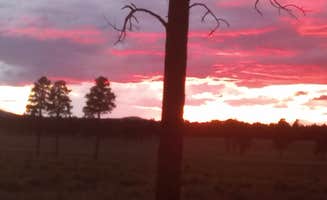
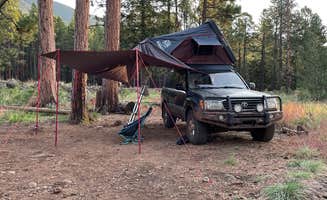
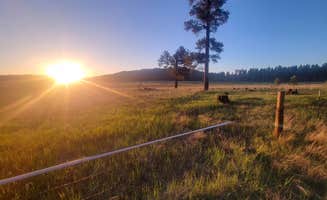
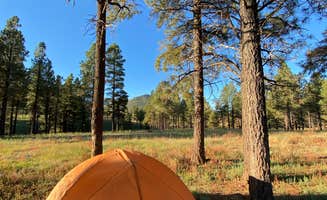
F328 dispersed camping spot
Road in was a little rough but to be expected with the amount of rain the area has had over the last month. Campsites are not on top of each other so you have privacy. AT&T cell reception LTE 4 bars.
Dispersed camping around Parks, Arizona occurs primarily on Coconino National Forest and Kaibab National Forest lands, with numerous free sites along forest service roads. Popular areas include FR 222, Garland Prairie Road, Freidlein Prairie, and the Edge of the World (East Pocket) area. Most sites are primitive with no facilities, situated among ponderosa pines and offering varying levels of seclusion. The region's proximity to Flagstaff, Williams, and Grand Canyon National Park makes these sites convenient base camps for exploring northern Arizona.
Forest roads in the area range from well-maintained dirt to rough, rocky terrain requiring careful navigation. Many sites are accessible with standard vehicles, though some areas like Edge of the World and Walker Hill may require high-clearance or 4WD vehicles. According to one visitor, "The road into the campgrounds are very rough, small cars are not advised." Most dispersed sites have established fire rings, though seasonal fire restrictions are common during dry periods. The standard 14-day camping limit applies throughout these national forest lands, and campers must pack out all waste as no facilities are provided.
These forest areas provide a quieter alternative to developed campgrounds, with opportunities to see wildlife and enjoy stargazing. "The surrounding areas are beautiful and a family of deer made appearances regularly," noted one camper at Freidlein Prairie. Sites vary in popularity, with some areas remaining relatively uncrowded even during peak seasons. Visitors frequently mention the peaceful settings and night skies, though proximity to highways can create ambient noise at some locations. Cell service is generally available near Flagstaff but becomes spotty in more remote areas. Campers should be prepared for variable weather conditions, as temperatures can drop significantly at night due to the higher elevation (around 7,000 feet) of many sites.
"Nice flat areas for camping. Very upsetting to see most of the sites are littered with trash."
"Didn’t see any wildlife but I’m sure they are around! No amenities so come prepared for dry camping. Flagstaff is about 15 min away and had good AT&T service and was able to work remotely."
"We just kept driving along a pretty rugged dirt road until we found a site. Turned out to be great. Not a person in sight and very wooded."
"Very accessible. Large area. Do not need 4 wheel drive to reach a spot you can camp in. Other spots you might need high clearance."
"Due to the ease of access from Sedona and Flagstaff this campground sees a lot of action."
"Campground Review: Couple things to say about this campground... it's dispersed but in numbered lots and unless you have a high clearance 4x4 you must enter from West (89A)."
"The trail is a commitment as it can take 2 hours or so to get up. But once you’re there it’s so nice and peaceful. There are no facilities, you do get decent service near the edge."
"I rented a camper van for my desert road trip with my daughter, and read about this spot on Dyrt, the pictures look breathtaking and I really want to try and get here to see it for myself."
"Great camping and I only went about 1.5 miles up the dirt road as my camper is new to me and I didn't want to go to far off the beaten path in case i needed something from town."
"Easy to find and the dirt road was great for a car. Stopped in mid-March and there was still a few places with snow and it got down to 30 degrees at night."
"The sites are a very good distance apart so that you don't even see or hear your neighboring sites."
"It was easy to navigate there and find the spot, but the road was a bit bumpy."
"Beautiful trees, morning cows, easy dirt road, only drove about 3 mile in, seemed safe, no one ever came close to camping near us! It was great!"
"Cell signal is pretty good depending on where you’re located."
"The road in was dry but had ruts from muddy times but doable with our 26' travel trailer. 20 min drive back to Flag but there is a truck stop close by."
"Road had easy access to various areas to camp. Close to Hwy 40 so there was some traffic noise. Overall, a nice place to stay."
"Close to highway, but tolerable. A few different sites. Really close to town."
"Very close to flagstaff. The campground was nice and spaced out. A bit loud with cars driving by."
"This was our first time boondocking in the forest of Williams, AZ. "
"Found a quiet, level spot not to far from the road leading to Dogtown Lake. Spent 4 days/3nights."


Road in was a little rough but to be expected with the amount of rain the area has had over the last month. Campsites are not on top of each other so you have privacy. AT&T cell reception LTE 4 bars.
Easy to access, multiple spots with fire pits, super close to Grand Canyon visitor center. Road wasn’t bad.
Great little stop over. Close to Grand Canyon. Good cell. A few cars go bye here an there but overall a super nice spot.
Definitely my favorite campground in the area. There’s shade and more privacy than the other flat ones. It gets crowded on the weekends and there is also a decent amount of people during the week. Be sure to get here before 2pm on weekends.
No electric sites here, full offgrid!
Quiet spot with plenty of parking bays; suitable for 30-foot vehicles. The access road is good, though there are a few potholes at the beginning.
The road up to this is fine for almost all rigs, the turn into the campsite will be tight. They have no camping signs along road 525c, although the map from the forest shows camping is allowed along this road. Make a right on road 9529 and there is a great campsite immediately on the left. It has a circle turn around. Incredible views, great hiking and no one around for miles. The BLM camping on road 525 is crowded. No one on this road. I get the sense they are trying to get people not to camp, but the maps show it is completely allowed. We are here in October and the weather is 70 degrees. Note that when dirt roads get wet, it is a whole different story. Coordinates are 34.87989889666775,-111.94793655703302.
I did buy a wilderness pass from the Arizona forest service. $20 for the year.
No camping allowed for 1st part of road, but then multiple flat, shaded campsites.
This is a great spot with 360 views and stellar sunsets. There is no shade and it gets pretty warm with the sun beating down. There are quite a few large spots to accommodate big rigs. HOWEVER- I arrived on a Monday around noon and got one of the last spots. Several campers have arrived looking for spots since I got here (it’s Tuesday). This is clearly a popular spot so have a back up plan. All the campers are closer than usual for dispersed camping. But they were all quiet during my time here.
Dispersed camping near Parks, Arizona provides free backcountry sites within Kaibab and Coconino National Forests at elevations around 7,000 feet. The forest roads range from well-maintained dirt to challenging rocky terrain depending on recent weather conditions. During summer months, daytime temperatures typically reach the 70s-90s while dropping to the 40s-50s at night, creating significant temperature swings that campers should prepare for.
Explore lava formations: The Lava Tube Cave on Forest Road 171 offers a unique geological experience just a short hike from camping areas. "The lava cave was a decent hike but my two year old and pregnant fiancé made it down and up. Camp ground not crowded but the cave was," reports Charles G. from Lava Tube Cave Path on Forest Road 171.
Fishing at nearby lakes: Several dispersed camping areas provide access to fishing opportunities. "Fishing at Dogtown was excellent! Got one short of limits of trout (4ea,) in a little over an hour," notes Jerry H. who camped at Dogtown Lake Road Dispersed Camping.
Wildlife viewing: The forests around Parks provide opportunities to observe local wildlife. "We were here two nights ago and my son wanted to come back. I wasn't even sure where we were, but we managed to find it again in the same spot," writes Gisele J. at FR 222 Dispersed, noting the peaceful forest setting that attracts wildlife.
Secluded forest sites: Many dispersed camping areas offer sites with privacy among ponderosa pines. "There are plenty of spots off 151, in the middle of gorgeous Ponderosa forest. The road is accessible by all cars I would think. There are a few aspens scattered here and there," explains violet W. from Hart Prairie - Dispersed Camping.
Spectacular overlooks: Some sites provide dramatic views of the surrounding landscape. "Incredible place to camp. The views are some of the best you'll get for sure," states Katelin M. who camped at Edge of the World (East Pocket), which features clifftop views.
Established fire rings: Most dispersed sites come with pre-existing fire rings. "We came here last minute because we were unable to get to a different site with our car. There was an already built fire pit and the ground is pretty flat in areas for tents," shares Mikayla M. from FR 222 Dispersed.
Seasonal road closures: Winter conditions can make access impossible. "Attempted to camp on 3/10 but road to campsites was closed," reports Michael B. who tried to access Pumphouse Wash.
Variable road conditions: Forest road conditions change with weather and seasons. "The road to campgrounds are very bumpy when you first enter," notes brendan from Pumphouse Wash (FR 237) Dispersed Camping Area.
Trash management concerns: No facilities means packing out all waste. "Wayyy to many sites with trash and toilet paper everywhere. You can't walk away from your site without seeing lots of trees surrounded by toilet paper. Freekin disgusting," cautions Michael C. about Pumphouse Wash.
Noise considerations: Some areas experience noise from recreational users. "We have a 26 ft class c RV and there was plenty of spots for us. There were a lot of ATVs and dirt bikes which were pretty noisy but other than that this place was great," comments Drew R. about FR 222 Dispersed.
Look for level ground: Families with multiple tents need relatively flat areas. "Lots of open space and plenty of sides to choose from. Lots of trees and not difficult to find," mentions T&J R. who camped at Garland Prairie Rd Dispersed Camping.
Consider distance from highways: For safer family camping, choose sites further from main roads. "My wife kids and I genuinely enjoyed the little spot we found off the 151 forest service road. We found several service roads that branched off the main service road that led to our little gem of a spot in the yellow and gold aspens," shares Nicholas D. from Hart Prairie.
Find open space for activities: Some sites offer room for children to explore safely. "Very quiet spot we had with our friends camping for the weekend. It is open range in the evening we do have some cattle around us but not in our campsite," notes joel G. from Garland Prairie.
Assess vehicle access first: RVers should scout roads before committing. "Though it was a mission to get to the spot, me personally I would say it's worth the effort to get to the spot. It is a bumpy road with large portion of potholes so drive cautiously," advises Angel T. from Edge of the World.
Look for turnout camping: Many forest roads have widened areas suitable for larger vehicles. "We never made it to the campground. The rocky trail ended with a flat tire on our truck (as we were hauling our truck camper). We were looking forward to the views, but we were forced to turn back," warns Joe F. about his attempted trip to Edge of the World.
Prepare for unexpected weather: Higher elevations mean rapid weather changes. "Plenty of room. Easy to find and the dirt road was great for a car. Stopped in mid-March and there was still a few places with snow and it got down to 30 degrees at night," reports Aaron H. about Lava Tube Cave Path.
Frequently Asked Questions
Are permits required for dispersed camping in national parks?
Dispersed camping is generally not allowed within national parks themselves—it's primarily permitted on national forest or BLM land surrounding parks. Most national parks require backcountry permits for any overnight stays outside developed campgrounds. Near Grand Canyon National Park, areas like Coconino Rim Road, Fire Road 310 Kaibab Forest offer permit-free dispersed camping just outside park boundaries. Similarly, Dispersed Camping around Sunset Crater Volcano NM allows camping on forest roads near the monument without permits. Always check specific regulations, as some areas may have seasonal restrictions or closures.
What is dispersed camping?
Dispersed camping is free, primitive camping outside of designated campgrounds on public lands, typically in national forests or BLM areas. It offers more privacy and flexibility with fewer restrictions than developed campgrounds. Fire Rd 688 - Dispersed exemplifies this with quiet, wooded sites away from road noise where campers can stay for up to 14 consecutive days. Similarly, Lockett Meadow Dispersed Camping offers vast, breathtaking areas with numerous sites. Dispersed camping follows 'Leave No Trace' principles, requiring campers to pack out all trash and waste. Most sites are first-come, first-served with no reservations needed.
What amenities are available at dispersed camping sites?
Dispersed camping sites typically offer minimal to no amenities. You should expect to be fully self-sufficient. At Freidlein Prairie Dispersed Camping, the only provided features are basic fire rings at some sites, with rough access roads and no facilities. Some dispersed sites like Walnut Canyon Rd Dispersed Camping (currently closed until 2025) may have existing fire rings from previous campers, but no trash service, restrooms, picnic tables, or water. Campers must bring everything they need, including water, waste disposal systems, and food storage. Cell service is typically limited or nonexistent, and you'll need to pack out all trash and human waste.
Keep Exploring