Primitive camping near Grand Canyon National Park occurs in both ponderosa pine forests and high desert terrain, with elevations varying from 6,000 to 8,000 feet. These campsites on Kaibab National Forest and Bureau of Land Management lands experience significant temperature swings, with daytime to nighttime temperature differences often exceeding 30 degrees, particularly on the North Rim where overnight temperatures dip below freezing even in summer months.
What to do
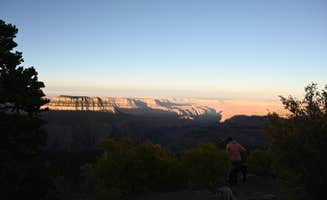
Sunrise viewing at canyon edge: Some dispersed sites on the North Rim place you directly at canyon viewpoints. At Saddle Mountain (Kaibab NF), campers report exceptional morning experiences. "We car camped here for two nights while we did day trips into the park. It's a great way to avoid all the campers and noise inside the park. We had a huge bull elk with his cows walk right past our camp," notes Hugh M.
Hiking to secluded viewpoints: Many free camping areas connect to less-trafficked trails. "Great spot, easy access and 6 miles from the South entrance to the Canyon. Note: The directions land you in an area with lots of no camping signs. Just keep driving and the spots open up. Great trails for biking here too," says Mike M. about Forest Service Road 328.
Wildlife observation: Elk sightings are frequent at primitive sites around the canyon. At Long Jim Loop Campground, campers regularly encounter wildlife. "LOTS of wild elk in the area," reports Megan A., while Emily K. notes, "It's elk country, an elk came to visit us at night, scared the hell out of me at first but I'm from Colorado so I know how to avoid them and let them carry on."
What campers like
Solitude and quiet: Unlike established campgrounds, many dispersed sites offer significant privacy. At Clear Creek Area Dispersed, campers appreciate the isolation. "Gorgeous and wild. Clear water to swim in, trees to hang from, and sandy beach areas to chill and relax in. I don't want to say too much because it may give away spots that are for the people that want to get away from everything and everyone," writes Jenn L.
Direct canyon access: Some free sites allow camping exceptionally close to the rim. "Been here couple days now. Plenty of room and other campers around. Feel isolated but not totally alone. Fire pits around as well. 10 minutes outside the park," notes Nicole K. about Forest Service Road 328.
Dark night skies: The remote locations provide exceptional stargazing opportunities. "The stars out here are beautiful, and I didn't hear the road traffic cause we were in the back 40 area," reports Emily K. at Long Jim Loop, while at Coconino Rim Road Dispersed Camping, Julie M. notes, "Lots of space on flat land" ideal for nighttime viewing.
What you should know
Road conditions vary significantly: Many roads to primitive sites deteriorate rapidly in wet weather. At FS328 Dispersed Campsites, Dennis C. advises, "Once you enter Rd328, the first 1/4 there is no camping allowed. After that, the next 1/4 mile seems to be numbered lots, so I'd say those are off limits. However, after that first 1/2 mile, there are several (I counted at least 8) spots to pull off and camp at with firepits."
Seasonal closures affect access: Winter camping options become limited, particularly on the North Rim. "If google maps wants you to go anyway besides the main road 67 to the turn off DON'T do it. The road seasonal can close and even though it was open Google put my 4WD to the test," warns Cheri C. about Saddle Mountain.
Cell service is unpredictable: Coverage varies dramatically between areas. "The cell coverage was good enough for phone calls no problems but internet was really hit and miss. Mostly miss," reports Alice S. about Long Jim Loop. For those needing connectivity, Ray & Terri F. note at Coconino Rim Road: "AT&T coverage was weird, varying between 4 bars of LTE service, to 4 bars of 4G, to 4 bars of 3G(mostly), to no service."
Tips for camping with families
Safety buffer from edges: For families with young children, select sites away from direct rim access. "There are many dispersed sites down the road as you head into the area. About 3 miles back is a view point of the East Rim with camp bathrooms. Will take about 15 mins to drive there from main road," suggests Jennifer about Grand Canyon North Dispersed camping.
Access to emergency services: Choose sites closer to park entrances or towns when camping with children. Forest Service Road 328 provides a good balance as Cole P. notes: "Great spots. Long road with lots of pull offs. I doubt you would have any issues ever finding a spot here no matter how busy it gets. Closest free camping to the entrance of the grand canyon."
Shelter from elements: Temperature variations can be extreme, so select sites with natural windbreaks or shade. "The campground in GC has a free dump station and potable water. It's a bit tricky for a big rig but doable," reports Robert G. about Grand Canyon North Dispersed, noting facilities to refill water when camping with families.
Tips from RVers
Site selection for larger vehicles: Many primitive sites have size limitations. At Tusayan Dispersed Camping FS Road 302, Jeremy W. advises: "Perfect spot in the Forest super close to town for a quick run in to the toilets at the gas station if need be. Lots of helicopters flying over from about 9am. Only 2 other vans there when we were and very spread out. Easy and roomy."
Turnaround space considerations: Forest roads often lack good turning areas for larger rigs. Connor N. reports about Forest Service Road 302: "Spent 4 nights in early December. Road in was fairly smooth with minor washboard, and sites were relatively easy to identify. Verizon service was fair, averaging 2 bars 4GLTE during our stay."
Leveling challenges: Many sites require significant leveling for RVs. "There are a few sites, kinda close together but not so much it would bother. Very well marked. Lots of wood to make fire," notes Carolina C. about Long Jim Loop, while others mention the importance of scouting sites before bringing in larger vehicles.











 Traveler


