Camping opportunities near Havana, Arkansas span elevations from 500 to 2,753 feet, creating distinct climate zones across the region. The area features numerous primitive and developed sites within Ozark National Forest and around Lake Dardanelle. Winter temperatures at higher elevations can drop 10-15 degrees lower than surrounding valleys, while summer highs typically reach the mid-90s.
What to do
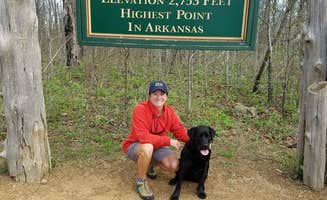
Hiking to mountain overlooks: The trails around Mount Magazine State Park Campground offer various difficulty levels with elevation changes that reward hikers with valley views. "The hike up to the highest point in Arkansas is easy and family friendly for kids," mentions Jeremy C., while more challenging options exist for experienced hikers.
Rock climbing opportunities: Mount Magazine provides designated climbing areas along its bluff faces. "Magazine is one of the few parks that offers climbers great opportunities to work their skills. The park essentially sits on top of a bluff that is nearly surrounded on all sides by straight rock face," notes Donny S.
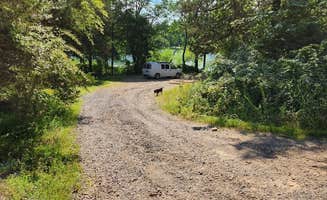
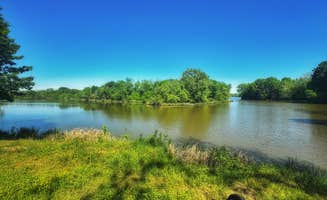
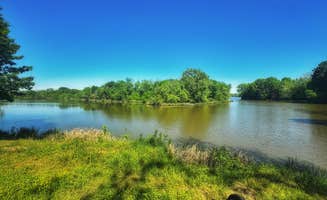
Fishing at multiple access points: Spring Lake offers bank fishing in a primitive setting. "This site is mostly used for bank fishing on Spring Lake. Its a large loop at the end of a short narrow Forest Road 96001F," explains Fred S. The location provides direct water access without the crowds of larger campgrounds.
What campers like
Temperature variation: The higher elevation campgrounds provide natural cooling during hot summer months. "The temperature is literally about 10-15 degrees cooler on the mountain than below. One night we were there it got down to mid teens," reports Donny S. about Mount Magazine State Park.
Wildlife viewing opportunities: The forested areas around Eickleberry Road dispersed camping offer chances to observe native wildlife. "Except for wonderful nature sounds, very quiet and peaceful night," notes Fred S. Many campers mention encounters with deer, birds, and small mammals.
Privacy between sites: Most established campgrounds feature good separation between camping spots. "Camping spots are spaced out pretty well," mentions Jeremy C. about Mount Magazine, while at Cove Lake Complex, "Sites are extremely spacious and well spaced from each other, and would feel even more private later in the season when the trees are full," according to Taryn S.
What you should know
Primitive sites require preparation: Dispersed camping areas lack facilities. "No amenities" at Spring Lake dispersed camping and "a permit is required to camp here; see COE Web site for info" explains Fred S. regarding Ashley Creek Recreation Area.
Cell service varies widely: Connection is unreliable at many camping areas. "No AT&T and T-Mobile cell service" at Eickleberry Road dispersed camping, while "T-Mobile cell service" is available at Ashley Creek. Other sites report spotty coverage.
Fog and weather considerations: Mountain roads can become hazardous during certain conditions. "It frankly isn't safe at all to drive on the mountain in the early morning or evening. I've included a picture to give you an idea of the type of fog I had to drive through," warns Donny S. about Mount Magazine access.
Seasonal facility closures: Some amenities close during winter months. Several campgrounds have limited services in off-seasons, and shower facilities may be unavailable.
Tips for camping with families
Lodge accommodations: For families needing more comfort, Petit Jean State Park offers non-camping options. "The lodge on top of the mountain is spectacular and looks like something you would see in the mountains of Colorado," reports Donny S., noting that "Most of the rooms in the lodge have private balconies that look out over the mountain."
Swimming opportunities: Cove Lake Complex provides water recreation for children. "There is swimming, boating, (stocked) fishing, hiking, and pretty drives," says Lynn G., adding that they have "canoe rentals on site, lots to do in this park/campground but still feels in touch with nature."
Choose campground loops carefully: Not all camping areas are equally family-friendly. When staying at Petit Jean, Shana D. advises, "RESERVE EARLY to get a spot in Loop A or Loop B. We stayed in Loop C and I felt a little too secluded."
Campground bathrooms vary: Facilities range from primitive to modern. "The restrooms/showers are a 4.5 out of 5 for state park facilities," at Mount Magazine according to Gary F., while Petit Jean's showers are described as "not very private other than a nasty mildewed shower curtain."
Tips from RVers
Site leveling challenges: Many campgrounds feature uneven terrain. "Many sites are unlevel and require significant leveling chocks to get it truly level," warns Ryan S. about Petit Jean State Park's B loop, a common issue across the region's mountainous terrain.
Access road considerations: Mountain roads require caution with larger rigs. At Piney Bay, Emily R. cautions, "Roads are narrow as are spots. The spots also say they're 'big/long enough' for a 42' rig but in reality it's super tight."
Hookup placement varies: Utility connections aren't always conveniently located. "Some sites have water and the picnic table on the opposite sides of the camper. it's purely inconvenient and I'm not sure why this is this way," notes Ryan S. at Petit Jean State Park.
Site selection based on shade: Summer temperatures affect comfort in RVs. Ryan S. recommends Petit Jean's A Loop for its full hookups but warns it has "very little shade. would be rough in summer months without shade tents, awnings, etc."












 Scout
Scout


