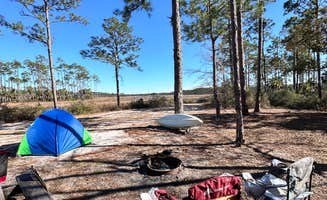
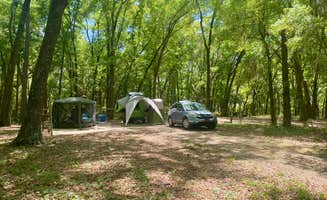
Apalachicola National Forest spans over 630,000 acres with diverse camping opportunities throughout its longleaf pine forests and cypress wetlands. Summer temperatures regularly exceed 90°F with high humidity, while winter nights can drop below 40°F. Most forest service roads become challenging after heavy rainfall, with standing water common in low-lying camping areas.
What to do
Fishing from established docks: At Camel Lake Campground, campers access multiple fishing spots. "Clean restroom, great host, and good fishing," notes one visitor. The lake supports various freshwater species throughout the year.
Night sky viewing: Light pollution is minimal at more remote sites. "At night total quiet, just the wildlife," reports a camper at Porter Lake Dispersed Camp. Clear winter nights offer excellent stargazing opportunities from December through March.
Trail hiking: Several campgrounds connect to forest trail systems. "The lake has a hiking trail encircling it," mentions a Camel Lake visitor. Most trails are flat, with loop options ranging from 1-5 miles in length, suitable for novice hikers.
What campers like
Lake swimming access: Designated swimming areas provide relief during hot months. "Swimming area as well," reports a camper at Camel Lake, while another notes, "there is a swimming area and I was able to put my kayak in for a nice paddle."
Wildlife viewing opportunities: The forest hosts diverse wildlife year-round. One camper at Ochlockonee River State Park mentioned, "While I didn't see any gators, there were signs warning about them. I did see several deer, a raccoon, and some lizards." The park is also known for its unique white squirrels.
Boat launching facilities: Several camping areas provide direct water access. "The river is beautiful to boat or kayak and fish," writes a Porter Lake visitor. Mack Landing offers additional boat ramp access to the Ochlockonee River for larger watercraft.
What you should know
Variable water availability: Not all sites offer potable water. At Porter Lake Dispersed Camp, "There is a boat ramp, pit toilets and water available here," but another camper notes "They say non potable but there are no signs." Always bring drinking water or purification methods.
Limited cell service: Connectivity varies widely across the forest. At Whitehead Landing NF Campground, campers report "Decent Verizon signal, no T-Mobile." Many remote areas have no service regardless of carrier.
Weather-dependent road conditions: Forest roads deteriorate quickly during rain. "Nice roads lead to this gem," says one Porter Lake visitor, but conditions can change rapidly. Many campgrounds require traveling dirt roads that may become impassable for low-clearance vehicles after heavy rainfall.
Tips for camping with families
Insect preparation: Biting insects are prevalent year-round. At St. George Island State Park, visitors warn "Nats and mosquitos really bad, take bug spray and fans," and another notes "the bugs—definitely recommend mosquito nets and a thermacell."
Beach alternatives: For coastal camping with children, consider parks with managed beaches. "The sand is sugar white and clean, minus some seaweed. We saw a few dolphins from a distance and collected some neat shells," reports a St. George Island camper.
Site privacy considerations: Campground layouts vary in privacy. At Ochlockonee River State Park, "Set back in palms and live oak, the campground is private with some sites very private and others not at all. The best sites seemed to be #7-9 and #18-21."
Tips from RVers
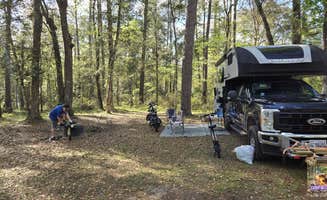
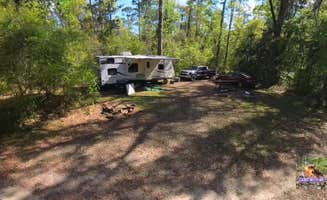
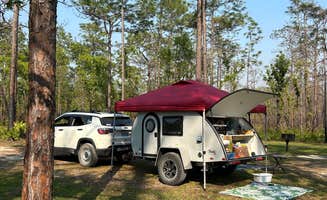
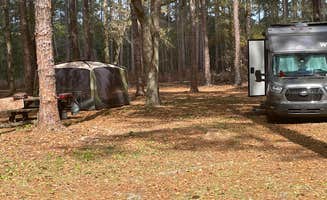
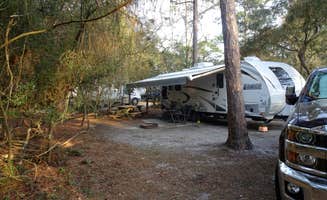
Site size limitations: Large rigs face challenges at most forest campgrounds. At Ho-Hum RV Park, "Nice park. All pull through sites except for waterfront," while at Porter Lake Hunt Camp, one RVer notes "We have a 23 ft class c rv and we got through the dirt road drive to get there and there was plenty of space for us an probably a bit bigger of rv could fit."
Utility access considerations: Hookups are limited in national forest camping areas. "Only four of the spots have electrical," reports a Camel Lake visitor. Most primitive sites offer no hookups, while established campgrounds typically provide water and electric at designated sites.
Leveling challenges: Many forest campsites require leveling equipment. At Ochlockonee River State Park, "The road among the sites and the sites are all dirt but level to the eye. Only the handicap space has a concrete pad (#23)."










 Legend


