The greater Seattle region offers year-round camping opportunities for pet owners, with Kenmore positioned near several forested areas that transition from urban neighborhoods to more secluded natural settings. Most campgrounds near Kenmore are under 500 feet elevation with moderate temperatures averaging 45-75°F throughout camping season. Winter camping often brings muddy conditions with 37 inches of annual rainfall concentrated between November and March.
What to do
Lakefront activities: At Vasa Park Resort, campers can enjoy direct lake access for swimming and paddling. "Beautiful beach area, basketball courts, playground, and volleyball right at the site," notes Erin A., who found the waterfront amenities particularly accessible even during shoulder season.
Trail exploration: The walking paths around Tolt MacDonald Park provide both riverside and forest experiences. Mercedes D. mentions, "The suspension bridge is pretty cool, but hold onto your phones tight because it could slip through the holes into the river below." The park connects to longer hiking routes through surrounding woodland areas.
Wildlife observation: Several campgrounds feature small lakes or ponds that attract local wildlife. At Flowing Lake Park, waterfront sites provide opportunities for birdwatching. "The lake access with boat launch and fishing dock" makes this location ideal for observing aquatic species according to Mindy P., who recommends fall camping for best wildlife viewing conditions.
What campers like
Heated accommodation options: For cooler weather camping, Fay Bainbridge Park offers cabin rentals alongside traditional tent sites. Judy J. appreciates the beachfront location but notes, "Beautiful beach, great views of Mt. Rainier & Baker on a clear day, cruise ships going by, pirate ship playground for children." These amenities make shoulder season visits more comfortable.
Proximity to urban conveniences: Campers appreciate how Lake Pleasant RV Park balances natural setting with nearby services. John M. explains, "Close to Seattle, feels secluded, but you can walk or take a short drive to restaurants, groceries, anything you could want or need." This makes it practical for visitors who forgot supplies or need to restock during longer stays.
Clean facilities: Many campgrounds maintain exceptionally clean bathrooms and common areas. At Tall Chief Campground, reviewers consistently mention facility cleanliness. Terri comments about Lake Pleasant that "The facilities were very clean, laundry was great and very affordable! Lots of geese, ducks, and bunnies are around the property."
What you should know
Campsite privacy varies significantly: Site separation differs dramatically between campgrounds. At Dash Point State Park, Brittany D. was impressed by "how spread apart the sites were," noting the "privacy between each of the camping spots." Other parks have more condensed layouts with minimal separation between neighboring campers.
Limited sewer hookups: Several campgrounds lack direct sewer connections. Derek & Alex W. note that "no sites have sewer hookups" at Tall Chief Campground, explaining that "a service needs to pump the septic tank by the dump station for the entire park." Budget $60 for mid-stay pumping service if staying longer than 3-4 days with heavy water usage.
Seasonal closures and limitations: While many campgrounds operate year-round, some facilities close during winter months. Bathhouses, showers, and water connections may be winterized from November through March, even when camping remains available. Research current status before arrival, especially during transitional months.
Tips for camping with families
Playground access: Flowing Lake County Park features exceptional play areas for children. Ryan O. describes it as "awesome for little kids. Amazing play structure." Several other dog-friendly campgrounds near Kenmore include dedicated children's areas with modern equipment suitable for various age groups.
Beach quality considerations: When selecting a waterfront site, research the swimming area conditions. Ryan O. notes at Flowing Lake, "The swimming area is also just rock and mud. A few loads of sand would make it infinitely better." Campgrounds with maintained sandy beaches tend to be more comfortable for families with young children.
Cabin options for easier family trips: For families new to camping, several parks offer cabin rentals that simplify the experience. Marisa N. explains that at Flowing Lake, "The cabins are heated and have bunk beds, which makes for a cozy retreat into nature in the winter." These accommodations reduce equipment needs while still providing an outdoor experience.
Tips from RVers
Power limitations: Several campgrounds have older electrical systems with limited capacity. At Tall Chief, Derek & Alex W. experienced challenges during hot weather: "We ended up here during a heat wave and an entire section of the park blew after having several days of power issues." Larger RVs should confirm amperage availability before booking, especially when planning to run air conditioning.
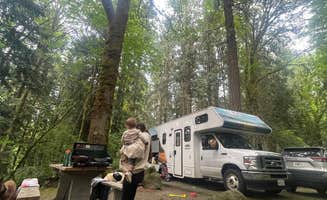
Site access and navigation: Entry points and interior roads vary in width and condition. Erin A. advises about Vasa Park Resort: "When you're arriving the turn into the property is tough...easier to pull into their overflow across the street and drive straight in." Larger rigs should research approach routes and turning radii before arrival.
Storage options: Some parks offer short-term storage for travelers taking side trips. John M. found this helpful at Lake Pleasant: "They also have a small storage lot that can accommodate short storage. I camped, stored my camper while I went on a cruise, camped and then headed out for the remainder of an around the country journey."















 Legend


