Tent campsites near Iron River, Michigan sit at elevations of approximately 1,500 feet in the Ottawa National Forest region. The area receives over 180 inches of snow annually, making summer and early fall the primary camping seasons. Forest roads accessing remote campsites often become impassable during spring thaw, typically limiting access until late May when ground conditions stabilize.
What to do
Waterfall exploration: Several cascades are accessible within 30 minutes of Iron River campsites. At Burned Dam Campground, campers can walk directly to Mex-i-mine Falls. According to Kay K., the campground offers "small campground near a falls. Sites are private."
Paddling opportunities: Perch Lake provides calm waters ideal for canoes and kayaks. Kirsty G. noted, "There is access to the lake from our campsite" at Perch Lake Campground, adding that the "hike to these sites is very short. We paid when we parked."
Fishing access: East Bass Lake Park offers shoreline fishing with two designated campsites. As reviewer GA J. describes it, "While there is only 2 spots for camping in this town park. It is a great place for those who want some solitude. Small sites for tent or pop-up... right on the lake."
Wildlife viewing: Early mornings provide opportunities to spot deer, eagles, and occasionally bears. At Perch Lake, camper Kirsty G. warned, "There is no bear box and there definitely are bears (during one camping trip some hunters treed and shot a bear in the early morning and we saw them carrying it while hiking out) so you'll want to hang your food."
What campers like
Solitude and privacy: Three Johns Lake Dispersed offers complete seclusion as the only campsite on the lake. User hesselinkj notes it's a "tents only. Short walk to campsite only one on lake. 5 dollar parking national Forest."
Free camping options: Multiple no-fee campsites exist throughout the Ottawa National Forest. At Paint River Forks Campground, camper Clint B. found "5 or so campsites. Clean out house right on river. Just a mile or so down the dirt road."
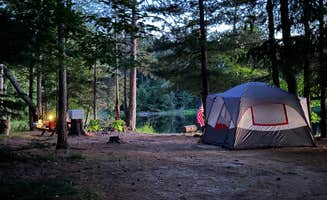
Lake and river proximity: Many campsites provide direct water access. Stevens Lake Campground reviewer Max S. wrote, "We rolled in at dark and were enchanted by trees, falling leaves and mystic lake... The morning greeted us with a misty fog and raining leaves. After breakfast the fog burned off and the mirror surface lake showed her magic."
Natural soundscapes: The sound of flowing water enhances many camping locations. Art S. described Burned Dam Campground: "Camp is right on a river and the rapids will draw you in. Follow the trail 20 yards and you can find a variety of boulders or logs to perch upon."
What you should know
Insect preparation: Biting flies and mosquitoes can be overwhelming, particularly in June and July. At Burned Dam Campground, Art S. warned, "Free. Lots of flies. Small. Right on rapids at river... The flies were quite bothersome so we decided to move on."
Limited cell service: Most forested campsites have minimal connectivity. Stevens Lake Campground has "Poor cell service for AT&T" according to Max S., while Paint River Forks has "Cell service is 1/10" according to abbi G.
Road conditions: Many access roads require high-clearance vehicles. Blockhouse Campground "requires driving down a dirt road that branches off another dirt road. It's 8 miles down the road with major washouts," according to Clint B.
Water availability: Pack adequate drinking water as many sites lack potable sources. At Perch Lake, most sites require carrying in all necessary water, as no pumps or spigots are available.
Site reservations: Most forest campgrounds operate on first-come, first-served basis. East Bass Lake Park limits stays to "2 day maximum consecutive days stay" according to GA J.
Tips for camping with families
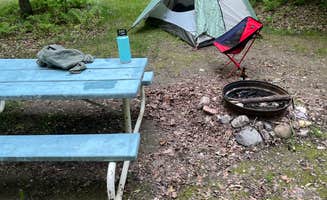
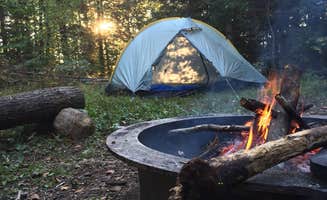
Best beginner sites: Perch Lake offers an ideal introduction to primitive camping. Kirsty G. notes, "It's a great place to camp if you want to experience being in the woods for the first time... There is a fire ring and picnic table at each site."
Weather preparation: Temperature swings can be significant, even in summer. At Boulder Junction, camper Liz D. shared, "The weather was a bit cold on Lake Superior and our picnic was ruined. However we had a great laugh making sandwiches in the car in a middle of a rain storm."
Wildlife encounters: Children should be educated about proper food storage. Store all scented items securely to prevent attracting bears and other wildlife.
Navigation awareness: Forest roads can be confusing. Boulder Junction camper Liz D. recounted, "We had fun exploring in the woods and getting lost! Good thing we had Lucas to guide us towards the river."
Tips from RVers
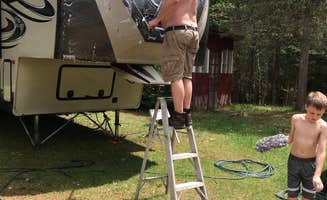
Site limitations: Most dispersed camping areas accommodate smaller rigs only. At Paint River Forks Campground, the sites can fit modest-sized RVs but larger motorhomes should avoid these areas due to tight turning radiuses.
Generator policies: Many sites prohibit generator use to maintain the quiet atmosphere. Bring sufficient battery power or solar options for extended stays.
Leveling challenges: Prepare for uneven terrain at most sites. Bates Township Park camper Dan S. noted sites "have some slope toward lake. Being only one there I found flat spot to tent but if busy choice might be limited."
Security considerations: Some remote areas require extra vigilance. Paint River Forks camper abbi G. cautioned, "I love it here! However, as the camper above mentioned, probably not a safe place for anyone that is alone. It is free and therefore attracts vagrants."







 Guide
Guide


