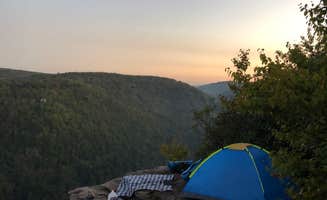
Dispersed camping options near Buckeye, West Virginia range in elevation from 2,300 to over 4,000 feet within the Monongahela National Forest. The region experiences significant seasonal variations with summer temperatures averaging 75-85°F during day and 50-60°F at night, while winter brings frequent snowfall that can make forest roads impassable. The high-elevation campsites often feature spruce forest environments not commonly found elsewhere in the state.
What to do
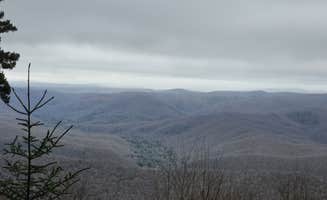
Hike through old-growth forest: Gaudineer Knob offers a unique hiking experience through moss-covered forest floor with towering spruce trees. A camper describes it as "just wow... miles of moss and other than the trail that was it. No other trees either... That combination created the world's most quiet environment ever." The half-mile loop trail leads to panoramic overlooks, with numerous small campsites along the route. Each site typically includes a table and fire ring.
Mountain biking on maintained trails: Dispersed camping at Mower Basin provides access to an extensive trail network specifically designed for mountain biking. One visitor notes, "There is a gorgeous network of trails defined as multi-use but designed particularly for mountain bikers, complete with berms, moguls, and generally sufficient width for navigating without hanging up a handlebar. Most noteworthy: the trails are beautifully groomed, well-maintained."
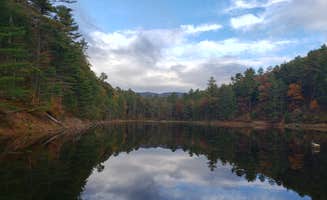
Fish in stocked waters: Braley Pond Dispersed Camping & Day Use Area offers fishing opportunities in a stocked pond. According to a reviewer, "The pond is stocked with trout in season, check DGIF site for dates." Though swimming isn't permitted in the pond, "we did wade the stream, which was cold and clear and beautiful," mentions another visitor. The site also features trails along the pond's edge for additional recreation.
What campers like
Complete disconnection from technology: The remote nature of free camping near Buckeye means limited or no connectivity. At Poor Farm Dispersed Recreation Area, a camper notes it's "a nice free camp spot(s) next to a river... No cell coverage. Highly recommend for primitive camping." This disconnection extends across most dispersed sites in the region, creating opportunities for genuine outdoor immersion.
Spacious sites with privacy: Little River Dispersed Campsites offers particularly private camping areas. One reviewer described their site as "breathtaking, with a small stream pool running along one edge, and the rushing river on another. Soft dirt padded the entire area, and great trees filled the space with their natural architecture and canopy... It was a mansion in terms of campsite sizes."
Star viewing opportunities: The high elevation and minimal light pollution create exceptional conditions for astronomy. At Mower Basin, one camper reported, "The moon was bright but you could still see hundreds of stars." The ridge-top locations of many dispersed camping areas provide unobstructed views of the night sky not available at lower-elevation campgrounds.
What you should know
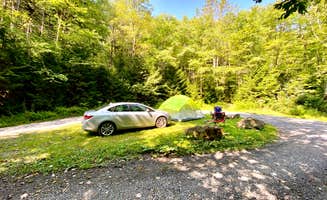
Road conditions vary dramatically: Access to many sites requires navigating rough forest roads. For Stonecoal Dispersed Camping Area, a visitor notes, "Nice little area within Monongahela National Forest... Good quality dirt access road, no problem for my Honda Civic." However, other areas like Little River require more caution as one camper warns, "We drove in from the south, through Durbin, which is almost 7 miles on a pothole ridden dirt road. Dangerous for RVs, great for those looking for an escape."
Wildlife encounters are common: Bears are active throughout the region. One camper at Little River reported, "Not even 2 minutes from our dispersed camp site we were charged by an extremely aggressive black bear... We decided to keep ALL FOOD in the car's trunk those nights and not hanging in a tree just to be safe." Proper food storage is essential at all dispersed sites.
Weather impacts accessibility: The high elevation means rapidly changing conditions. Sites often become inaccessible in winter, and one Mower Basin reviewer cautioned, "Because of its remoteness and high altitude, it could be impassable for any vehicle in winter when there's heavy snow." Many forest roads are not maintained during winter months, limiting camping opportunities.
Tips for camping with families
Choose sites with water features: Elk River Dispersed camping provides riverside sites that appeal to children. A visitor reports, "We set up camp right next to Rose Run, just East of the closed off bridge. Along this road you will see areas to pull off where people have set up fire rings." The shallow water areas offer safe exploration opportunities during warmer months.
Look for established campfire rings: At Braley Pond, a family camper shared, "The day use area is close enough to use the bathroom (just an open pit toilet, nothing fancy)... There are fire rings, firewood, and enough room to pull in, pitch a large tent, (ours was a 10-person) and hang hammocks." These established areas provide structure that helps with family camping organization.
Bring activities for variable weather: The mountain environment can produce unexpected conditions. Pack games, books, and rainy-day activities as a backup. At Little River, a camper mentioned, "It rained a lot while we were there but there were ample trees to set up tarps." Having shelter options and activities that don't depend on good weather ensures successful family trips.
Tips from RVers
Site selection is critical: Forest Road 227 offers some of the most accessible dispersed camping for smaller RVs. According to a camper, "There are a lot of campsites along this road, many of which could fit an RV, but many of which have some rough roads that an RV or trailer might not do well on. Each site has a clear marker put there by the Forest Service." Scout sites before committing to a location.
Leveling challenges: The mountainous terrain means few naturally level sites. One Mower Basin camper noted, "We strolled up the mountain in our 39ft skoolie. It snowed and we had a really good time!" However, larger rigs require careful positioning and leveling equipment. Bring extra leveling blocks as the terrain is rarely naturally flat.
Bring sufficient supplies: No services exist at dispersed sites. For overnight stays, ensure your RV has adequate water, power, and waste capacity. As one visitor to Mower Basin advised, "Really remote. I'm pretty sure the nearest hospital is at least an hour away, and I never get cell phone reception at any of the sites I have camped at."








 Ranger


