Tent campsites near George Washington & Jefferson National Forests provide wilderness camping at elevations ranging from 1,000 to 4,000 feet. The region's mixed hardwood forests create natural shade and wind breaks for tent sites during summer months when temperatures average 75-85°F during the day. These forests span across 1.8 million acres of Virginia, featuring diverse topography from mountain ridges to river valleys.
What to do
Fishing near campsites: The streams alongside Dispersed Camping Site off FR 812 offer direct water access for anglers. According to one camper, these sites are "along a gentle stream, and all had huge fire pits," making them convenient for combining fishing with camping.
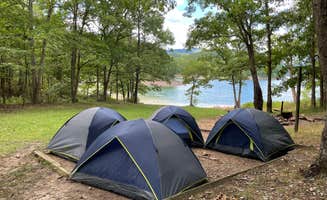
Kayaking opportunities: Water-based recreation serves as a major attraction in the area. At McClintic Point Primitive Campground, "there is access to the lake for canoes/kayaks" and "two sites back up to the lake," allowing for convenient water entry for paddlers.
Stargazing: The limited light pollution makes this region ideal for night sky viewing. Campers at Walnut Grove note the "night sky was amazing. You could see stars for miles," while others mention that you can "just ask for a telescope (free at the store) and stare up at the sky for hours!"
What campers like
Natural separation between sites: Tent sites at Switzer Lake Dispersed Camping offer privacy despite being free. One camper described, "There is a huge variety of spots, starting from huge ones right on the lake to more secluded, smaller spots deeper in the woods along the creek," providing options for different preferences.
Stream access: Water features enhance many camping locations. One visitor to Dispersed Camping Site off FR 812 noted it has "large open space with several flat areas for tents... and easy access to the stream," making it practical for both camping setup and recreation.
Wildlife viewing: The forests support diverse fauna. Campers should secure food properly as one visitor to Switzer Lake Dispersed Camping warned: "There are bears here, so lock up your food in the car. We have encountered a bear at or around the campsite 3 times."
What you should know
Road conditions vary significantly: Access to more remote sites can be challenging. At Canoe Landing Group Campsite, campers appreciate that "the parking area is very close by," while at Switzer Lake, visitors warn "the road is a mix of gravel but also dirt so it can become muddy during rain."
Cell service limitations: Most dispersed sites have limited connectivity. One camper at Switzer Lake stated clearly: "Just a heads up, there is no cellphone signal for any carrier from what I could tell," requiring advance planning for safety.
Temperature fluctuations: Mountain elevation creates weather variations. A McClintic Point camper noted the area "seems to stay chillier than the surrounding area. It's in a valley" suggesting campers should pack for cooler temperatures than forecasted.
Tips for camping with families
Consider walk-in difficulty: Some sites require carrying gear from parking areas. At Walnut Grove, campers warn: "We were not prepared for the stairs. They say walk in but it's more a short hike. So getting our gear (we aren't minimalist people) in was a workout but worth it."
Water safety precautions: Many tent sites access natural water features with varying safety conditions. A reviewer at Canoe Landing Campsite noted: "Swimming is not advised due to rocks and drop-offs, but people were in the river, anyhow," suggesting supervision for children.
Bathroom availability: Facilities vary widely between locations. One family camping at Walnut Grove appreciated that "the bathhouse looked like it was fairly new. Loved that the showers were individual stalls accessed on the outside of the bathhouse."
Tips from RVers
Site surface considerations: Vehicle-accessible campsites have different ground preparations. A camper at Walnut Grove mentioned the "site was crushed rock, which wasn't ideal," suggesting RVers bring leveling blocks and ground pads.
Access road clearance: Several forest roads require higher clearance vehicles. At Hog Camp Gap, "you do have to carry all the stuff from your car to the campsite but luckily you don't have to walk too far because the parking area is right near the camping area."
Self-sufficiency requirements: Most dispersed sites require bringing all supplies. A camper at Hog Camp Gap advised: "There is a spring but remember to boil or chemical treat the water before use" and recommended "investing in a portable toilet," highlighting the need to prepare for limited facilities.









 Legend


