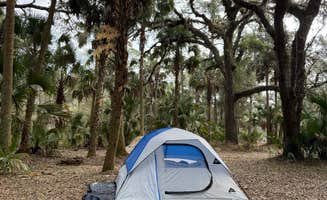
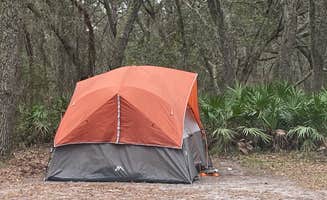
Ocala National Forest covers 387,000 acres of protected wilderness in central Florida, featuring over 600 lakes and springs amid pine scrub ecosystems. Tent camping in this forest varies from primitive dispersed sites requiring complete self-sufficiency to semi-developed areas with basic vault toilets. During summer months, nighttime temperatures rarely drop below 70°F, while winter camping typically experiences mild 40-60°F nights with occasional frost.
What to do
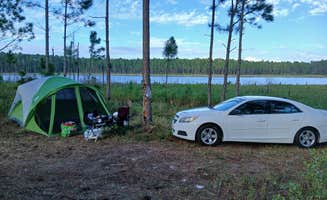
Paddling access: Multiple tent camping locations offer direct water access for kayaking and canoeing. At Lake Dorr Cabin, campers receive "canoes/paddles/life jackets on site" and enjoy "your own private boat slip, 100ft long dock for fishing & swimming," according to Aubrey O.
Wildlife viewing: Sawgrass Island Preserve provides excellent opportunities for spotting Florida's diverse wildlife. "I have seen several whitetail deer, sandhill cranes, lots of other birds, quail, and some turkeys while hiking. I also saw a black bear up a tree in the marsh," reports Tracy L H.
Hiking trails: Multiple hiking routes connect throughout the forest. At Lake Delancy East NF Campground, "Florida hiking trail is about 200 yards away," notes Daniel S. Sawgrass Island offers varied trail options: "I like to go across the causeway and down the Bog Button Trail and over to the Hammock Trail and along the Cactus Trail."
What campers like
Quiet seclusion: Many sites provide genuine isolation from crowds. Freak Creek Dispersed Camping is described as "super secluded and quiet" by Adamm A., who notes "sites are primitive" and there's "barely a cell signal."
Swimming spots: Natural water features offer cooling relief. Bluff Landing has "a small zip line over the creek and a rope swing. Doesn't look deep but there's a super deep hole you aim for," explains Adamm A., who adds "water is clear and cool."
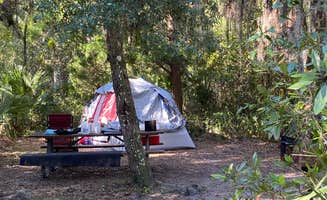
Shade coverage: Forest canopy provides relief from Florida sun. At Caravelle Ranch Wildlife Management Area, Stuart K. notes "just about everywhere you might want to pitch a tent, there was substantial tree shade to block an otherwise unrelenting hot Florida sun."
What you should know
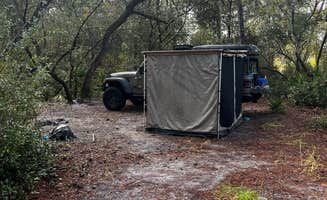
Vehicle requirements: Many primitive sites require appropriate transportation. For Freak Creek, hilary G. warns "The main road in has huge deep ruts, the other road has a water crossing that was over my bumper on my lifted Mojave... If you don't have 4wd and recovery gear I wouldn't risk it."
Limited facilities: Prepare for minimal or nonexistent amenities. At Trout Lake Primitive Sites, Entropical Breeze E. reports it's a "set of primitive spots near lake" with "very narrow tree clearance" and "poor cell service even with booster."
Varied road conditions: Forest access ranges from maintained to challenging. Lake Delancy East has graded dirt roads, while Joe P. mentions Trout Lake's "very narrow trails" where "you will leave with some new pinstripes."
Tips for camping with families
Water safety precautions: When camping near water features, establish clear safety rules. At Lake Dorr Cabin, features include "canoes that come with the cabin" which provide family-friendly water activities, with Sara S. noting "it was a great 'base camp' for everyone to stay at."
Space considerations: Some sites accommodate larger family groups better than others. Lake Dorr Cabin "sleeps 6/8 comfortably and has 2 tent sites as well," according to Aubrey O.
Budget management: Ocala National Forest Farles Prairie Recreation Area offers affordable access to tent camping near the Florida Scenic Trail. As Peggy M. notes, "If you're hauling water gear or want to hike/backpack a section of the Florida Scenic Trail, this is a lovely place to hang out on the small lake."
Tips from RVers
Size restrictions: Large rigs face significant limitations on forest roads. At Bluff Landing, Adamm A. cautions "I have a 36ft 5th wheel and it sounded like I'd have the ability to get there. Well, I did, with a few broken dishes and messing up the camper a bit."
Parking alternatives: Some sites offer separate parking areas for larger vehicles. Brian observes at Bluff Landing there is "a parking area just past the camping turn off though with room for a trailer."
Road preparation: Sand presents specific challenges for RVs. Adamm A. warns roads at Bluff Landing "are mostly sand and a lot of dips and mud holes from all the 4wheeling... my truck broke down trying to get through the roads. It's easy to get to in 2 wheel drive and just about any vehicle. But 4x4 is recommended."









 Scout


