


Steven P. Traveler
TravelerOttawa Lake Campground — Kettle Moraine State Forest - Southern Unit
Nice
Nice campground not far from Milwaukee.
13 campgrounds · Check availability for any dates.
Southern Unit Horseriders Campground in Kettle Moraine State Forest provides dedicated facilities for equestrians camping near Milwaukee, Wisconsin. Located in Palmyra, this campground features electric hookups, water hookups, and fifty-amp service suitable for larger horse trailers and RVs. The campground maintains toilets and showers for visitors, with picnic tables at each site. Sites are reservable and accommodate both tent and RV camping options. The campground operates seasonally from April to November. Sites are well-maintained with flat, spacious areas for setting up camp while keeping horses nearby.
The extensive trail system throughout Kettle Moraine State Forest offers excellent riding opportunities directly from the campground. Horse trails connect to the wider network of paths throughout the Southern Unit, allowing for rides of varying lengths and difficulty levels. Riders appreciate the well-marked trails that wind through diverse terrain including wooded areas and open fields. Water is available for horses at designated locations throughout the campground area. The park enforces quiet hours and maintains clean facilities even during busy summer weekends. Trailer parking is available at each site, with ample room for vehicle maneuvering. Alcohol is permitted in the campground area, and pets are allowed for those bringing dogs along with their horses.
"Nice little lake. Within 1/2 hour of Milwaukee. My favorite sites are the 2 walk to sites. I believe #334 and 335"
"In that situation, I choose Ottawa Lake for several reasons."
from $26 - $41 / night
Check Availability"There are miles of nice hiking trails, a nice beach, pavilions to rent, horse riding trails, archery range and I’m sure I’m missing more."
"The park has a lot of trails for hiking, biking and some horse trails. The quarry is good for swimming, kayaking, or canoeing. There is a beach with life guards."
from $25 - $80 / night
Check Availability"It is close to the Ice Age trail and the Scuppernong trail, and a short drive from Ottawa Lake. Nearby is some excellent mountain biking in hilly terrain at the Emma Carlin and John Muir trails. "
"Pinewoods Campground is part of the southern Kettle Morraine State Forest in Wisconsin. The campground is secluded and most sites are private and shaded."
from $26 - $90 / night
Check Availability"You can’t go wrong with how close the park is to Milwaukee."
"I live very close to this park and camp here often. It is a nice family type campground with a nice swimming beach and playground for children."
from $26 - $41 / night
Check Availability"We stayed at site 98- just barely big enough to fit our travel trailer in and right next to the showers and bathrooms. Not a great location, but fine."
"This is one of the most popular State Parks in Wisconsin because it's on Lake Geneva. In fact, it's the only state park within town's limits."
from $24 - $39 / night
Check Availability"Has trails, disc golf, and rock river for kayaking."
"Their is also a great hiking trail if you like that."
"In the Turner loop, the pit toilets are next to the path to the fishing pier, while the showers and full restrooms are between Turner and Fox den, there is a short path between sites 60& 61."
"Trails were geared more towards horses and bikes, but there are plenty of walking paths, and we were able to find some hidden trails along the lake (read: unofficial)."
"There is a lot to do at this park from hiking to water sports to horse back riding. We did a nice short hike in area. We had a great time at this campground and would visit again."
"It feels like you are in the middle of nowhere, but it is close to everything. "
"Driving on country roads to this campground, I drove past many many horse ranches. So it's no surprise that there is a dedicated campground for horseback riding in this state park. "
from $26 - $70 / night
Check Availability"Within walking distance to downtown Elkhorn, EAHS, and the horse areana. You might even be able to catch a show or two on site at the fair grounds, depending on the time of year."
"Easy access to electric and/or water. If unsure, contact office. Site, restrooms, and showers were clean. There are a lot of sites but still felt like there was ample space."
TravelerNice campground not far from Milwaukee.


 Legend
Open tent sites and well designed riggings and beyond excellent, well-maintained trails, accommodations and hospitality. This was an opportunity I couldn’t pass up, so if you’re looking for this kind of experience, don’t pass it up. In one of the most lush forests in the SE corner of Wisconsin near Milwaukee.
 Legend
We stayed in the Turner lake south loop, which has nice and private sites. This is in contrast to Honeysuckle hollow which is open and row after row of RV sites. Fox den and Prairie view loops are nice as well with mostly primitive sites. Be aware that the map on www.ExloreMoreIL,com(where you make your reservations) doesn't show where the restrooms are. In the Turner loop, the pit toilets are next to the path to the fishing pier, while the showers and full restrooms are between Turner and Fox den, there is a short path between sites 60& 61. Facilities are clean and well lit. Fire pits are slightly raised steel troughs with a heavy adjustable grill. This is a BIG park, the campgrounds are two miles from the front gate, and it's a drive to the main boat launch at Maple Grove, where you have access to the Fox River and Grass lake. This location has a huge parking lot for boat trailers, a very well stocked general store with fishing supplies, a cafe, boat rentals and good firewood. To get away from the crowd if you're a canoeist or kayaker it's nicer to leave the park and go back in at Oak Point picnic area and boat launch at the northern border. This will put you on the Fox river with developments to the north(including a bar& grill) or to the south which is all nature. I think the distance by boat between the two launches is 4-5 miles, but I'm not sure, Halfway there you'll meet up with the Goldfinch trail which is the shortest loop and the most diverse in term of flora. There are horse/ snowmobile trails, but no equestrian campground. Chain o' Lakes is one of the busiest waterways in Illinois, with motorboats everywhere in the height of the summer season. We canoe, and both times we stayed there it was October, so I can't tell you how crowded, but the vast number of picnic areas must be there for a reason. An odd thing is that you can hear a Steam Train whistle quite often, this is from Richardson's Adventure Farm in Spring Grove. We don't have kids so we went to Stade's Farm& Orchard(which is also large and kid friendly) because they have an orchard and vegetable market. One last thing, the gates close at 10:PM and there are tire shredders, you can leave but you can't get back in… unless you want to walk 2+ miles in the dark:)

 Scout
ScoutLove this park. Nice little lake. Within 1/2 hour of Milwaukee. My favorite sites are the 2 walk to sites. I believe #334 and 335
ScoutMauthe has several great wooded sites. You can’t go wrong with how close the park is to Milwaukee.
 Scout
ScoutSometimes you don't have time to plan a long camping trip, or something special. In that situation, I choose Ottawa Lake for several reasons. First off, it's just about an hour from home so even if it's Friday morning and I decide to leave town, I can get there by sundown that day and still get some work done beforehand. Plus, I've been camping here since I was a kid. I know the amenity list by heart (see below). It's close to Scuppernong nature trail with springs bubbling out of the ground. For longer hikes, the Ice Age Trail is nearby as well. For bird watchers, it's a great place as all the water in the area brings a wide variety of birds. Even without leaving the Ottawa Lake area you might see cranes, wild turkeys and other fowl wandering across the highway and into the campground area.
Kids will find things to do on their own as well as with their parents which is great as well because sometimes you just want to quietly read a book in front of a fire but also want to take the kids with. Since I'm a new parent (my daughter will be three this year), this is a great bonus. A lot of the campers are there every year and so kids have opportunities to make friends that they will see year after year.
For a quick, get-out-of-Milwaukee-fast sort of camping trip, nothing beats Ottawa Lake in my mind and you can find me and my friends there regularly.
Amenities: Flush and vault toilets, showers, lake with swimming beach, kid's playground, water fountain (for drinking), electrical if needed, walk-in sites, sites with a view over the lake, volleyball, horseshoes, site host with firewood sales, and picnic areas. (As of fall 2016)
 Legend
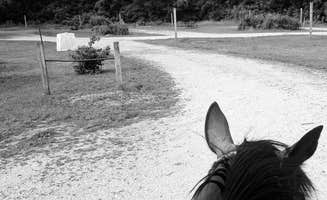
Driving on country roads to this campground, I drove past many many horse ranches. So it's no surprise that there is a dedicated campground for horseback riding in this state park.
Built for Large Gatherings
There are a number of COVID-era regulations that as of this writing are in place, see photos of the signs posted. This campground is clearly built for large groups to hang out together. There is a large shelter with picnic tables and very convenient roll-up sides that can be used to protect people during inclement weather. There is also a large grill that would be great for serving many, and a very nice fire pit with fixed seating for a large group.
Ammenities
There are also nice touches, such as a small stair-step for beginners or young people to mount their horse. And the campground has a little free library. There are electric and non-electric campsites, all seem to have a picnic table and fireplace. There are ample places to bridle horses and shared corrals every four or five campsites. There are also animal waste collection areas throughout the campground. There are several pit toilets throughout the campground, and one building with flush toilets and showers. It's a very nice and fairly new building.
Group Campsite
The group campsite has six sites and they are not pull through for trailers. There is a fire pit with fixed seating around it centrally-located in the group campsite. The group campsite does not have electric units.
And no surprise, there is easy access to horse trails throughout the state forest.
My Top Picks
There are several sites along one side of the park that are a little more secluded and in a pine forest. They have picnic tables and fire pits like the others, they include 409, 410, 411, 412, 413. There's also a series of pull-through sites that would make it easier for those who don't care to back trailers in or out of the site. These include electric sites 405, 404, 403, 402, and 401.
There's a nice couple of campsites at the end of one of the loops that affords a little bit of privacy, the only problem is they abut the main road and are a little noisy with car traffic. However, they are sweet sites. They include 427 and 428. Unfortunately, they camping here you would hear all of the car traffic while all the other campsites are much further away from the road.
 Traveler
I live very close to this park and camp here often. It is a nice family type campground with a nice swimming beach and playground for children. There is only 1 bath house here and MANY pit toilets that are surprisingly clean and not real stinky. It is part of the Northern Unit of the Kettle Moraine and there are great hiking and biking trails as well as horse trails with a horse camp nearby. Every once in a while you can spot an eagle soaring around dinner time. There are sites very near the lake, but I prefer the ones up the hill. Mosquitos are present in the early summer and the breezes topside keep them at bay.

 Guide
GuideStsyed on South side of the lake. Great for all campers whether privative or big honking buses. Within an hour of major suburbs of Milwaukee but out of the way. Clean a peaceful with great beaches, fishing, and hiking. Please reserve especially on weekends.
Kettle Moraine State Forest spans over 22,000 acres of glacial terrain across southeastern Wisconsin, providing numerous camping opportunities within a short drive of Milwaukee. The region features rolling hills, kettle lakes, and pine plantations formed during the last ice age. Winter camping is available at several campgrounds in the area, with temperatures averaging 20°F during January and February.
Hike the Ice Age Trail: The extensive trail system offers diverse terrain for hikers of all skill levels. At Mauthe Lake Campground, visitors appreciate the variety of paths. "There is a crushed gravel trail running from here to Long Lake that is great for running/walking/biking," shares Sarah L., who also recommends checking out Hamburger Haus in nearby Dundee for ice cream after hiking.
Kayak on multiple waterways: Several lakes and rivers provide paddling options throughout the region. "The lake is nice and there is a very nice beach as well as a fishing pier. I didn't take advantage of any of the hiking trails so cannot speak to those," reports Glenn S. from Ottawa Lake. For a different experience, at Turner Lake "you can see the fish swim by" according to Julia B., who adds "the water was very clear" but warns "the bottom of the lake is very mushy."
Mini golf and park activities: Beyond trails and water, some parks offer additional recreation. "The park has a 9 hole mini golf course that cost $1 a person. Has trails, disc golf, and Rock River for kayaking," notes Brittany R. about Harnischfeger County Park. The park caretaker John "knows every nook and cranny, critter and creature" according to Lauren S., who stayed as a camp host.
Secluded, wooded sites: Privacy ranks high among camper preferences in this area. At Pinewoods Campground, "The site was actually really lovely and I appreciated the thick brush creating some real seclusion," reports Kendal R. Jack D. recommends "loop 3 site 273" which was "well wooded and very spacious" with "a decent clearing for some sun and the driveway was longer setting it back from the loop road."
Quiet camping loops: Many campgrounds designate specific areas for noise-conscious campers. "We liked this site because it was on the 'quiet loop.' No radios or pets allowed," writes Wendy Z. about Kettle Moraine Southern Unit, adding "The quiet was perfect!" These designated areas provide respite from more active campground sections, especially during holiday weekends.
Winter camping options: Off-season camping provides solitude and unique experiences. At Ottawa Lake Campground, Tim H. notes "You can camp year around in this campground. Most recent 2 times were winter camping. No host so buying wood is an issue, but pick a site on the edge and there is more than enough free. Bring a saw. Nice place for solitude."
Campground selection matters: The different camping areas within Kettle Moraine vary significantly in terms of amenities and atmosphere. Josh F. explains that at Southern Unit Horseriders Campground, "There are several sites along one side of the park that are a little more secluded and in a pine forest... they include 409, 410, 411, 412, 413. There's also a series of pull-through sites that would make it easier for those who don't care to back trailers in or out."
Bathroom facilities vary: Campers frequently mention bathroom quality in their reviews. Kim from Menomonee Park notes "Pit toilets and metros desperately need to be cleaned more often," while others report clean facilities at different campgrounds. Most campgrounds offer both pit toilets near campsites and centralized shower buildings, though distances vary.
Reserve well ahead: Popular campgrounds fill quickly, especially for summer weekends. The most desirable sites can book months in advance, particularly at locations like Fox Den where Art S. advises "reservations would be important to make first" since the campground is "within a couple hours of Chicago so it makes a nice getaway for the weekend."
Look for dedicated play areas: Several campgrounds feature kid-friendly facilities. Menomonee Park offers "a nice beach with life guards," according to Matt N., who adds "The park has a lot of trails for hiking, biking and some horse trails. The quarry is good for swimming, kayaking, or canoeing." Kyle B. notes it's a "Fun little park to ride bikes through. Many trails to walk or hike. The pond has a great beach for kids."
Consider noise levels: Family camping experiences can be affected by neighboring sites. One camper at Menomonee Park reported "We had very noisy neighbors that did not respect the quiet hours rule and park staff did nothing to intervene." Jon shared a similar experience: "The biggest complaint is the noise into the wee hours of the morning. What good are quiet hours if they are not enforced?"
Choose sites strategically: Some camping areas are more suited for families than others. In Chain O' Lakes State Park, Marisa A. recommends "Turner Lake South and Mud Lake East for those hoping for privacy" and notes "The campsites are a little bigger in Turner Lake South," making them better for families needing more space.
Electric site availability: RVers should note the various electrical options. At equestrian camping areas near Milwaukee, Wisconsin, electrical hookups are common but vary in amperage. Fox Den Campground offers advantages over other nearby options as Ian C. explains: "Fox Den is superior to Honeysuckle Hollows because each site has an individual electric post. Sites in Honeysuckle have electric posts too far from parking pad."
Site levelness matters: RV campers emphasize the importance of level pads. At Fox Den Campground, Ian C. notes "Pads are pretty level, and each site has some semblance of privacy from other campers." Art S. confirms this assessment, adding that Fox Den has "more level pads and each site is tucked away with trees."
Campground road access: For those traveling with larger rigs, consider the location within the park. Art S. notes that Fox Den "was just about as far away into the park as you could go without going to the youth/group camp," which means a longer drive with your RV. Some campgrounds have narrower access roads that can be challenging for larger vehicles.
Frequently Asked Questions
Which is the most popular equestrian campsite near Milwaukee, WI?
According to TheDyrt.com, the most popular equestrian campground near Milwaukee, WI is Ottawa Lake Campground — Kettle Moraine State Forest - Southern Unit with a 4.3-star rating from 52 reviews.
What is the best site to find equestrian camping near Milwaukee, WI?
TheDyrt.com has all 13 equestrian camping locations near Milwaukee, WI, with real photos and reviews from campers.
Keep Exploring