







 Legend
Greenbrier State Park Campground
Nice hiking opportunities!
Ranger Review: Firebiner and Fiber Light Fire Starter at Greenbrier State Park
**Campground Review: **
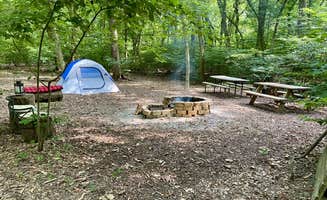
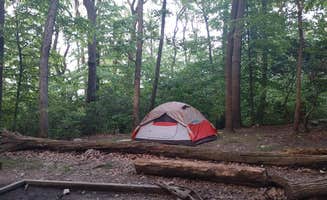
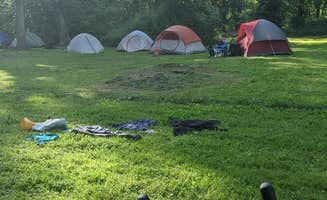
We were here one week before this campground closed for the season (open April through October) and it was so quiet that it was hard to imagine what it is like in the summer when the beach is open and the campground is likely full. There are four loops; two with no hookups and no pets allowed, one with no hookups that allow pets and one with electric sites that allow pets. Each site is clearly defined, and the sites all appeared level with gravel pads. The bathrooms were reasonable. There are several trails in the campground plus it is close to several AT day hikes.
There is a large day-use area and beach with lots of picnic tables. While the beach was closed for swimming, we saw a kayaker and two people fishing from a boat. Many hiking trails and this is an excellent place to camp if you’d like to do AT day hikes.
-------------------------
Product Review:
As a Ranger for The Dyrt, I have the opportunity to test products. At this campground, we tested the Firebiner and Fiber Light Fire Starter by Outdoor Elements. I’m reviewing both products since they can be used together, and we had much more luck with one than the other.
Upon unpacking my box from Outdoor Elements, my first experience was that it took a sharp knife to free the Firebiner from its cardboard backing, which was not an auspicious start. Once at our campground, we were able to use the safety blade to easily open the plastic packaging on our firewood. Unfortunately, it took several tries by two men trying the Firebiner to get a spark; they had to really crank on it, and it was not enough to light a fire. I’m guessing that with more patience and practice, it would have worked. Admittedly, we are car campers and not backpackers (and have the luxury of being able to carry/use a butane lighter), but I was looking forward to trying a new method.
We did use the Fiber Light Fire Starter and using our tried and true fire-starting methods, we got a roaring fire started very quickly. So, we had a 50% success! Packed in a small tin, you only need a pinch to easily get a fire started so we will use this in the future.
We also used the cutting tool on the Firebiner a few days later to remove the wristband from an activity we participated in and also used it to hang our lantern on a hook; this little tool is very strong (did not test but appreciate the 100-pound weight limit). I appreciate that it can also be used as a screwdriver, so the Firebiner is truly a multi-use tool!


