Sumatra, Florida sits within the expansive Apalachicola National Forest at an elevation of approximately 26 feet above sea level. The region experiences a humid subtropical climate with hot summers where temperatures often exceed 90°F and mild winters with occasional frost. Campsites in this area typically feature sandy soil with pine and palmetto vegetation, requiring appropriate tent stakes and ground preparation.
What to do
Fishing opportunities: The freshwater lakes and waterways near campgrounds offer excellent fishing spots. At Camel Lake Campground, visitors can fish from the shoreline. "The lake was pretty but small, more of a pond," notes one camper, though another mentions "good fishing" as a highlight.
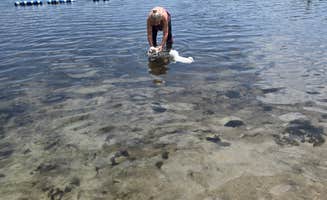
Paddling and kayaking: Launch points available at several water-adjacent sites. At Tate's Hell State Forest High Bluff Primitive Campsites, each location offers different water access. "We followed the step by step directions that were in the confirmation email and not google maps' directions and we had no problems," reports one visitor who enjoyed kayaking from the site.
Wildlife viewing: Dawn and dusk provide opportunities to observe native species. The campgrounds throughout the Apalachicola National Forest offer glimpses of local wildlife. "The Audubon society works so closely with this park to preserve its fine feathered inhabitants," notes a visitor at St. George Island State Park.
What campers like
Secluded camping spots: Many campers appreciate the privacy available at forest campgrounds. Wright Lake Campground offers well-spaced sites with natural barriers. "Distance between the sites was pretty decent with at least some demarcation between each with vegetation," writes one reviewer who enjoyed the perimeter sites.
Night sky viewing: Limited light pollution makes for excellent stargazing. At Tate's Hell State Forest, a visitor specifically noted they came during "the 2020 Leonid meteor shower" and found it to be a "nice place for dogs (req'd on leash) as no other campsites nearby."
Budget-friendly options: Several campgrounds offer low-cost or free camping with reservations. Florida River Island stands out as a no-cost option. "There are about 10 sites total at this free campground. There is a tent-only side with about 4 sites, with a pit toilet. The tent sites are much nicer than the RV sites," according to one reviewer.
What you should know
Seasonal insect considerations: Prepare for mosquitoes, especially during warmer months. At Dr. Julian G. Bruce St. George Island State Park Campground, campers consistently mention insect challenges. "Nats and mosquitos really bad, take bug spray and fans," warns one reviewer, while another cautions, "the amount of mosquitoes and other biting insects were unbearable. Insect repellent didn't work."
Flooding potential: Many sites can become waterlogged after heavy rain. A tent camper at St. George Island State Park reported, "It rained so much that our tent was virtually floating and we had to seek shelter in the bath house. We ended up getting a hotel that night."
Cell service variations: Reception differs significantly between campgrounds. Florida River Island has "good cell service with ATT and Verizon," while at Tate's Hell State Forest, campers note "marginal cell phone coverage (AT&T)" at some sites.
Tips for camping with families
Bathroom considerations: Not all sites have full facilities. Wright Lake Campground has improved but still basic restrooms. "Facilities seemed new and were very clean. The sites aren't clearly marked and there isn't much room between them," notes one family's experience.
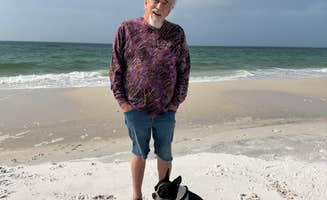
Swimming areas: Several campgrounds offer designated swim spots for cooling off. Indian Pass Campground provides water access that families appreciate. One visitor comments, "They are also extremely dog friendly which is a huge plus for us because our pup loves to swim."
Pet-friendly activities: Walking trails suitable for dogs with varying terrain. At Camel Lake Campground, one visitor warns, "There are 2 gators that live on the other side of the lake," suggesting keeping pets close while enjoying the "nice beach" area.
Tips from RVers
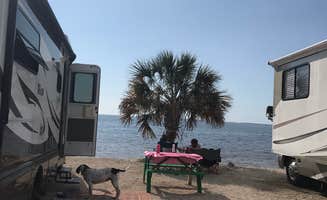
Site selection strategy: Choose outer loop sites when possible for more privacy. At Ho-Hum RV Park, waterfront sites offer significant advantages. "Get the ones that back to the ocean. Best views there," advises one RVer, though noting "March there is little beach available and reminder the water here is brown."
Hookup availability: Water and electric options vary widely between campgrounds. At Camel Lake Campground, campers should note that "the prices listed on the board are NOT correct. It is now $20 a night for non electric/water site and $30 for water/electric."
Road conditions: Some access roads require careful navigation. A Tate's Hell camper warns, "Dirt roads could be an issue if wet and for larger RV-type set-ups," suggesting approaching "from the east or north" for better access.








 Guide
Guide


