Dispersed camping near Lewisburg, West Virginia offers several primitive sites situated within the Allegheny Mountains and nearby valleys. The region includes over 100,000 acres of public lands across Monongahela National Forest and George Washington National Forest, with most sites at elevations between 2,000-3,500 feet. Winter temperatures can drop below freezing from November through March, requiring additional preparation for cold-weather camping.
What to do
Hiking trails: The Appalachian Trail crosses through the region near Walnut Flats, providing access to day hikes and thru-hiking opportunities. "Trail right through the campground and the Appalachian trail just across the road," notes one camper who stayed at Walnut Flats.
Wildlife observation: Bears are active throughout the area, especially during summer months. When staying at Army Camp, campers should be prepared for potential encounters. One visitor described the diverse wildlife: "Song birds, robins and crows competed vocally during daylight hours. Interesting insects crawled the river's sandy shore and a brightly colored Eastern box turtle searched for higher-dryer ground."
Fishing: The New River provides excellent fishing opportunities with multiple access points. According to a camper, "If you enjoy fishing, the New River Gorge website offers a lot of specific information about species, bait, and lures."
What campers like
Affordable access: Free camping is consistently mentioned as a major benefit in the Lewisburg area. At Poor Farm Dispersed Recreation Area, one visitor shared: "Really enjoyed this place. Maybe 5-10 min off of highway 220. There are maybe 5 ish spots to camp next to a river in this mountain valley."
Privacy between sites: Many dispersed sites offer good separation from neighboring campers. At Army Camp, "Outside perimeter sites are wooded and offer more privacy. Though all sites are separated by 50 ft or more."
Established amenities: Despite being free, several sites have basic infrastructure. A camper at Walnut Flats described the setup: "Nice little free campground with about 5 sites with grill fire rings level gravel drive with tent pad and lantern pole, restrooms but I didn't use them well water pump for drinking water."
What you should know
Cell service limitations: Most dispersed sites have poor or no cellular connectivity. A Poor Farm visitor warned: "No cell coverage," highlighting the need for advance planning and offline maps.
Water availability: Water sources vary greatly between campgrounds. At Johns Spring Shelter along the Appalachian Trail, one hiker noted its "lack of a good water source" and that "The closest one is about 3 miles North."
Early arrival recommended: Due to limited site availability and first-come, first-served policies, arriving early is crucial. "We were lucky and got one of the last spots, there's only 11," a recent Army Camp visitor shared. "If you're planning on coming here, make sure and come early."
Tips for camping with families
Water safety awareness: Rivers in the region can change quickly with rainfall. One Army Camp camper observed: "When breaking camp, it was noted the New River had encroached another 100ft through the woodland, flowing alongside the campground loop gravel drive...30 ft from our tent pad. Even though it had not rained in 18 hours, the New River continued to swell."
Wildlife education opportunities: The diverse ecosystem provides learning experiences for children. "Wildlife sightings are common in the area, particularly birds and small mammals. Some sites offer easier wildlife viewing than others.
Bring entertainment: With limited connectivity, plan offline activities. A visitor at Walnut Flats mentioned the campground was "Very quiet area," making it ideal for family games and nature exploration without digital distractions.
Tips from RVers
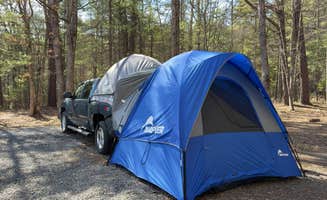
Road access considerations: Many dispersed sites have challenging access roads that may be unsuitable for larger vehicles. A camper who stayed at Army Camp noted: "Road to access is single lane paved/gravel. Best for cars/vans, but did see some small pull behinds."
Self-sufficiency requirements: RV campers must be prepared for off-grid stays. "You need to be self sufficient though, only convenience is a toilet house," explains a Poor Farm visitor, emphasizing the need to bring all supplies including sufficient water.
Length limitations: Most dispersed sites cannot accommodate larger RVs. One Army Camp visitor reported: "We got down there with our F250 truck and camper when a big grater and the park ranger came by. It's very doable. Campsites were mowed and it was a short walk to a really nice spot on the river. No electric/water, so plan to be ready to be off grid."






 Traveler


