Guadalupe Mountains National Park sits at the southern edge of the Rocky Mountains in West Texas, rising dramatically from the surrounding desert floor to over 8,700 feet. The park encompasses diverse ecosystems including desert slopes, riparian canyons, and high-elevation forests. Wilderness tent camping in the park requires backcountry permits, with sites typically located 3-8 miles from trailheads, demanding substantial hiking with elevation gains of 2,000-3,000 feet to reach the best tent camping near Guadalupe Mountains National Park.
What to do
Hike to higher elevations: From McKittrick Ridge Wilderness Campground, explore multiple approaches offering varying difficulty levels. "You need a permit to camp here. Two ways to approach with different difficulty levels, both 8 miles of backpacking and both are lovely. There's a little cave along the trail! Easy to follow, stunning views from most of the hike and from the campsite," explains Dan N.
Catch the sunrise from the summit: Schedule your hike to reach Guadalupe Peak before dawn for a special experience. At Guadalupe Peak Wilderness Campground, a camper advises, "We decided on a Monday in late July with a slight forecast of rain, and temps in the 50s-70s. I think we lucked out! We spent the night in the campground and woke up ready to catch the summit sunrise. We were the first ones to the summit and made it just in time to watch the sun crest over the horizon."
Combine parks in one trip: Visit nearby Carlsbad Caverns National Park while camping in the Guadalupe Mountains region. "While Carlsbad Caverns generally serves a one-day visitor, there is much more to see as the sun goes down. Permits are required for camping along the Rattlesnake Canyon Trail, but those are easily acquired at the visitor center," shares a camper at Rattlesnake Canyon.
What campers like
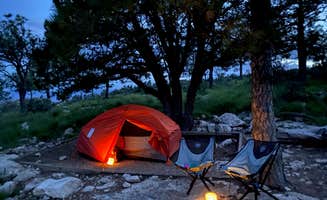
Protected forest camping: Tent campers at Tejas Wilderness Campground appreciate the forest environment. "Tejas Wilderness Campground is a hidden gem! The hike there is no joke, but once you get there, the peace and pine trees make it well worth it. Just make sure to get a backcountry permit and pack smart," writes Miller C.
Natural isolation: The remote locations provide genuine solitude away from crowds. At Bush Mountain Wilderness Campground, a visitor noted, "Bush Mountain holds a view of beauty and a land of wonder and amazement as you can awake and place your feet upon the lands of a thousand words."
Challenging hikes rewarded with views: The effort required to reach backcountry sites filters out casual visitors. "The hike from the Pine Springs Visitor Center to the Guadalupe Peak campground is 3.1 miles - and it is almost all uphill. The hike from the Guadalupe Peak campsite to the peak is an additional 1 mile," explains Troy W. about Guadalupe Peak Wilderness Campground.
What you should know
Permit requirements: All backcountry camping requires permits obtained at visitor centers. For Rattlesnake Canyon - Backcountry Camping near Carlsbad Caverns, "Permits are required for camping along the Rattlesnake Canyon Trail, but those are easily acquired at the visitor center. As the ranger shakes the dust off the backcountry binder, it's easy to tell just how few people use this option to camp inside the park."
Water planning: No water sources exist at most backcountry sites. "You'll need to carry all of your water for your ascent and descent so be prepared to haul 4 to 8 liters depending on the season, heat and personal needs," warns a Guadalupe Peak camper.
Tent pad limitations: Sites have minimal infrastructure. For Tejas Wilderness Campground, a visitor reported, "You'll want to bring a heavy duty tarp/ground cloth as many of the otherwise decent tent spots are pretty rocky."
Tips for camping with families
Choose sites based on season: The tree cover at certain sites provides important protection. A camper at Mescalero Wilderness Campground suggests, "For those who prefer a more densely forested setting, the extra distance to the Tejas Wilderness Campground is well worth the effort."
Plan for temperature swings: Desert areas experience extreme temperature variations between day and night. A camper at Tejas noted, "We were disappointed in the lack of view and the cold settled in fast. This would be a great site for the summer due to the tree coverage or on windy nights since you're protected."
Consider nearby alternatives: For easier access with children, look at adjacent areas. A visitor to Rattlesnake Canyon shared, "When I first saw this one I was a bit hesitant because of the name itself. I, a person petrified of snakes and also familiar that names are often given for a reason, was skeptical to say the least. But I wanted to try something a bit different and check into other camping options near Carlsbad."
Tips from RVers
Use developed campgrounds as base camp: Since backcountry sites are tent-only, RVers should consider staying at Pine Springs. "I stayed at the Pine Spring campground before hiking to Guadalupe Peak over Thanksgiving weekend. I got one of the last campsites so be sure to arrive early as they are first come, first serve," advises Richard M. about Guadalupe Peak access.
Generator restrictions: RV camping has noise limitations. "There are no hookups, but campers can run generators before quiet hours begin at 8pm," notes Carlyne F. about the campground access to Guadalupe Peak.
Day-use access: RVers can still enjoy the park without staying overnight. "It costs $15 per night to stay and there is a drop box to put your money. There are clean bathrooms, but no showers available," reports a Guadalupe Peak visitor.




 Ranger


