Tent camping at City of Rocks National Reserve offers access to a landscape dominated by granite formations reaching up to 700 feet tall. Most campgrounds within and near the reserve sit at elevations between 5,500 and 7,000 feet, creating significant temperature variations between day and night even in summer. Several primitive tent sites are positioned directly adjacent to popular climbing routes and historic wagon trail segments.
What to do
Climbing access: Bread Loaves Group Campsite provides immediate access to approximately 20 climbing routes within 100 feet of site 58. According to camper Alan B., "Within 100' of the site are ~20 routes and one of the mega classics of the City, Bloody Fingers on the east side of the loaves." The walls near this site face east, creating opportunities for night climbing.
Hiking to alpine lakes: From Independence Lakes Campground, visitors can hike 2.5 miles to the first of three mountain lakes. Camper Vanessa H. notes, "It's a 2.5 mile hike to the first lake. It inclines all the way up. You are treated with beautiful back country views, met with several switch backs before reaching the first lake." The trail continues past the first lake to two additional alpine lakes.
Mountain biking: Trails suitable for mountain biking start directly from some campgrounds. Angela S. reports from Bread Loaves Group Campsite, "It was such a great location for climbing and mountain biking. A trail started right at the parking lot, which is where the bathroom is too." The surrounding area contains multiple biking trails with varying difficulty levels.
What campers like
Isolation and solitude: Twin Sisters Group Campsite offers significant privacy between individual tent pads. James C. describes the experience as "Splendid isolation... Dark, quiet and starry at night with long views to the south. Lots to explore in locale." The campsite's location provides excellent stargazing conditions due to minimal light pollution.
Creek sounds: McClendon Spring Campground sites are positioned along a small spring-fed creek. Camper Becbecandbunny O. shares, "Situated by a pond with lots of birds made our stay very peaceful. Lights of a nearby town (Malta) could be seen from a distance making this spot even more lovely at night." The water source attracts diverse bird species throughout spring and summer.
Cooler temperatures: Higher elevation sites provide relief from summer heat. At Bear Gulch, Amanda M. explains, "We came up here looking to escape the heat of the city and were not disappointed. It was a good 10 degrees cooler and cooled off quickly when the sun went down." Temperature differences between valley areas and campgrounds can reach 15-20 degrees on summer days.
What you should know
Road conditions: Many campsites require driving on unpaved roads that deteriorate after wet weather. Regarding McClendon Spring Campground, Lauren C. warns, "We drive 3 miles with our TT on a long steep dirt road... If you have travel trailer, 4x4 is recommended as the road is rough and steep in places." Alternative routes often exist but may not appear on GPS navigation.
Limited services: Most tent camping areas have minimal or no facilities. At Third Fork Campground, Alan B. points out, "This is a no frills campground... Each site has its own fire ring and picnic table with most also giving you a shady spot to set up a tent if you want. There is only 1 vault toilet though near the info sign." Campers must bring all supplies including drinking water.
Seasonal considerations: Many tent sites are inaccessible during winter and spring due to snow or mud. Alan B. notes about Independence Lakes, "First and foremost this campground needs a high clearance vehicle to reach and is best visited in late summer fall as it is very marshy there earlier in the year." Some higher elevation sites remain closed until July when access roads become passable.
Tips for camping with families
Hauling gear: Some sites require carrying equipment from parking areas to tent pads. Angela S. shares about Bread Loaves Group Campsite, "We camped here in October during an unseasonably hot few days. We brought a camper and just parked it at the parking lot... the rest of the group set up tents and hammocks down at the actual campsite which is a short distance downhill. If you have a ton to pack... you may not like this site." Consider bringing wagons or carts for transporting gear.
Creek play: Several campgrounds feature small streams suitable for children. Colette A. reports about Independence Lakes, "We set up camp in the early evening. Hot and the flies were pretty thick. Evening came and it was perfect! Only two other tents that we could barely even see from our campsite. Felt like we had the whole place to ourselves. Loved hearing the creek as we tucked in for the night." Streams provide both recreational opportunities and natural white noise for sleeping.
Shade access: Limited tree cover at some sites creates afternoon heat challenges. At Third Fork Campground, Jeff F. describes, "Free 14 day camping along the creek at the Third Fork Trailhead. Multiple designated campsites along the creek." Securing sites with western shade helps manage afternoon temperatures during summer months.
Tips from RVers
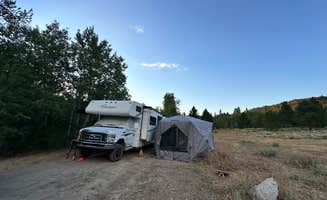
Parking limitations: Most tent camping areas near City of Rocks have restricted parking for larger vehicles. Cody E. experienced challenges at Independence Lakes Campground: "We stopped at this campground hoping it was Trailer Friendly. We were able to get up to the parking lot but I wouldn't recommend it. If my trailer was not lifted we would have had issues... You have to park and its a short walk to the campsites." Small trailers under 20 feet generally have more options than larger RVs.
Alternative navigation: GPS services often route vehicles on impassable roads in this area. For McClendon Spring Campground, Becbecandbunny O. advises, "Google maps led us down an unpassable road. Instead take Tiffler Road/1250 S from the 81 for a smoother ride (still dirt but passable in a 2WD vehicle)." Carrying paper maps or downloading offline maps helps when digital navigation fails in remote areas.






 Legend

