Tent camping near Winslow, Arizona concentrates primarily at higher elevations within Apache-Sitgreaves and Coconino National Forests. The region's pine forests typically sit between 6,000-7,500 feet, providing respite from Arizona's summer heat with temperatures often 15-20 degrees cooler than Phoenix. Cell service becomes increasingly limited as campers venture deeper into forest areas, with most dispersed sites having no connectivity beyond major forest roads.
What to do
Fishing at elevated lakes: The lakes around Winslow offer productive fishing opportunities. Blue Ridge Reservoir provides excellent swimming spots in summer, though campers should be aware of "crawfish like creatures in the water that liked toes," according to one FR95 Dispersed Camping visitor.
Stargazing in dark sky territory: Away from city lights, campsites offer exceptional night sky viewing. "We went during a new moon and the stars were fabulous," notes a visitor at Chevelon Canyon Lake Campground.
Wildlife observation: Dispersed camping areas provide opportunities to experience native wildlife. One camper at Dempost mentioned "nature and birds" as highlights, while another at Chevelon Canyon Lake Campground reported "the silence here was stunning—only interrupted by the bugling of elk."
What campers like
Pine forest seclusion: The region's dispersed sites offer significant privacy between campsites. A visitor to Dispersed Camping Coconino described finding "a lot beautiful sites. The trees are huge and spread out in a beautiful way that gives way to open spaces."
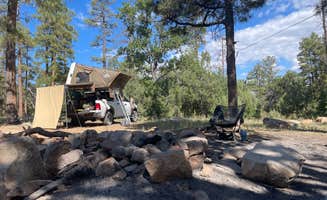
Fire-friendly camping: Most dispersed areas allow campfires in established rings when fire restrictions aren't in place. A camper at Dispersed Camping Coconino found "a great site with a cleared area containing a rock campfire ring. Lots of level spots for tents. Plenty of shade from the tall pine trees."
Off-grid exploration: The network of forest roads invites additional adventure. One group at FR95 appreciated "the seclusion of this site" and mentioned "lots of forest roads to explore with 4x4 vehicles or mini bikes."
What you should know
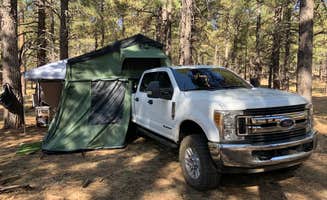
Vehicle requirements vary dramatically: Access to some sites requires high-clearance vehicles. At Forest Road 195 Campground, one camper noted "the roads off the main are VERY rough. In our Santa Cruz we had to go very slow and careful. Better suited for larger trucks with ample clearance."
Cell coverage limitations: Communication becomes increasingly limited deeper into forest areas. A visitor to Forest Service Rd 81 observed "Cell signal is sporadic, depending on the occupancy of the RV park down the road about 6 miles. More RV park campers means more cell congestion and slower speeds."
Water access challenges: Lakes may require substantial hiking effort. At Chevelon Canyon Lake, a camper warned it was "a 45 minute hike down through the canyon" and "extremely rocky" on return with "almost all non stop elevation gain."
Tips for camping with families
Consider elevation impact: Higher elevation camping means cooler temperatures, even in summer. A visitor to Long Lake Dispersed Camping mentioned camping "above 6,000 feet" where evenings can be notably cooler than daytime temperatures.
Prepare for wildlife encounters: Insects and small animals are common visitors. One FR95 camper reported "We did have to fend off lots of wasps while we were there," suggesting families should pack appropriate deterrents.
Evaluate lake access difficulty: Families should realistically assess hiking capabilities for lake access. A camper at Chevelon Canyon observed "We weren't prepared for how long of a hike down it was to the water. According to my watch, it was over a mile and 550 feet of elevation."
Tips from RVers
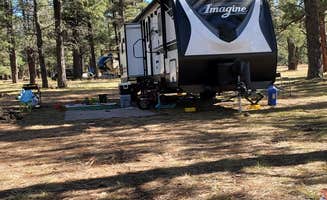
Size-appropriate site selection: Larger rigs should target specific dispersed areas. A visitor to Forest Service Rd 81 found "plentiful large sites, and big rig friendly" but cautioned about "a lot of OHV use on weekends."
Avoid narrow forest roads: Some access roads become increasingly challenging for wider vehicles. One reviewer noted Chevelon Canyon had "some rough road the last .5 mile before you reach the camp on FR 169B. Some of it had washed out and there are a few step areas."
Pack extra water reserves: With no potable water available at dispersed sites, RVers should plan accordingly. A camper at Chevelon Canyon emphasized "There isn't any potable water at this site or trash. Bring your own water. Pack it in, pack it out."






 Guide
Guide


