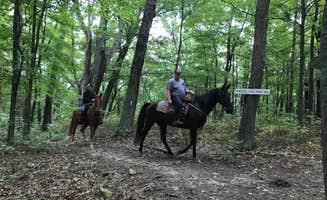
Equestrian camping sites near Stout, Ohio provide varied terrain for riders seeking both primitive and developed camping experiences. The region features heavily forested areas with multiple access points to trail systems specifically designed for horse riders. Weather in southern Ohio often creates challenging trail conditions, with seasonal precipitation affecting trail quality and campsite drainage across the Little Smokies area.
What to do
Trail connections beyond state park boundaries: Riders at Shawnee State Park Campground can access multiple trail systems that extend into surrounding forest areas. "The new campground is on the river on what used to be the golf course," notes Megan M., indicating expanded camping options beyond the traditional equestrian sites.
Cave exploration between trail rides: Within driving distance, Carter Caves State Resort Park Campground offers additional recreational options. "Lots to do hiking, fishing, caves and caverns to explore. Campgrounds was clean," reports Ron & Bonnie D., providing alternatives for days when weather conditions limit trail riding.
Lakeside recreation for non-riding days: The region includes water-based activities at several locations. "There is a small lake with a swimming beach and canoe rentals," reports Marc H., describing amenities available at Shawnee State Park when taking breaks from trail riding.
What campers like
Limited cell service creates true disconnection: The isolated nature of horse camping near Stout means technology takes a backseat. "Shawnee State Park was totally without any phone signal. Right on the border of Kentucky, in Ohio, you are in the small town almost South," explains Shelly S., highlighting the digital detox that accompanies trail riding trips.
Varied terrain difficulty levels: Riders appreciate the range of trail challenges available. "Unlike many Ohio State parks I've visited, the Shawnee campground has a variety of great tent sites," says Jay T., with this variety extending to the trail system where both beginners and experienced riders find appropriate routes.
Access to specialized equestrian facilities: Twin Knobs Recreation Area provides additional regional options with well-maintained sites. "The campsite that I was on was a double.(A30). It has electric, no water or sewage on the spot. We had 2 campers on the site with plenty of room," notes Karen P., highlighting the spacious layouts that accommodate horse trailers and equipment.
What you should know
Pack adequate water supplies: The limited water access at some horse camping areas requires preparation. "Not much access to a good town for supplies so bring what you need," advises Jarrod M., indicating the need for self-sufficiency when planning extended stays with horses.
Weather affects trail conditions significantly: Rain impacts both campsites and trails throughout the region. At Pike Lake State Park Campground, "It rained the first day we were there and people were literally bailing there sites out with buckets. The places that weren't flooded were very muddy," reports Kristin L., a condition that extends to equestrian trails after precipitation.
Reservation timing matters for peak seasons: The popularity of equestrian camping requires advance planning. "We reserved for the weekend. When we drove up to the campground we did not like the feel so we left," shares Betsy D., highlighting the importance of researching specific sites before committing, especially for groups with multiple horses.
Tips for camping with families
Multiple recreation options beyond riding: East Fork State Park Campground demonstrates the family-friendly amenities available in the region. "Many activities can be enjoyed here including mini golf (small nine-hole course), soccer, basketball, tennis, volleyball, corn hole, boating, and bicycling," according to Lee D., offering alternatives when younger family members need breaks from trail riding.
Tent-only sites provide better experiences: Families with both riders and non-riders should consider specialized site selection. "Several of these are hidden in the trees at the top of some steps and up a short path. We stayed in 12. If you don't mind hauling your gear a short distance from your car, sites like this are perfect," recommends Jay T., describing options that offer more seclusion.
Playground access varies by campground: Younger children need entertainment options when not riding. "There are two playgrounds, one in the campground and one right across the way," notes Shannon G., an important consideration for equestrian families with varied age ranges.
Tips from RVers
Extension cord requirements: Ashland Huntington West KOA demonstrates a common issue at horse campgrounds. "You will need extra water hose and extension cords to get hooked up in a lot of the sites," advises Ron & Bonnie D., as equestrian sites often place utilities at distances designed for horse trailers rather than RVs.
Site selection crucial for combination rigs: Horse trailer plus RV combinations require careful planning. "Most sites are only 30 amp electric, no sewer or water hookup, which can be typical of state parks," explains Carrie S., noting limitations even at developed campgrounds.
Specialized hookups at equestrian sites: The configuration of equestrian camping affects utility access. "The sites are labeled electric share one electric box for 2 campsites and can be pretty far from your pad," warns Amanda S., highlighting the need for adequate extension cords and adapters when camping with horses.




 Legend


