Rustic camping near Boise National Forest provides access to primitive sites across a varied landscape spanning 2.2 million acres of central Idaho. Elevations range from 3,000 to 9,800 feet with campsites distributed among ponderosa pine forests, mountain lakes, and sagebrush valleys. Summer temperatures can fluctuate 30-40 degrees between day and night, requiring campers to pack accordingly.
What to do
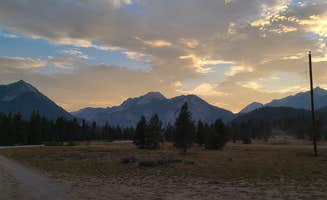
Fishing access: Several dispersed camping areas offer direct river or lake access. At Nip and Tuck Rd, campers can find spots with "great views of the Sawtooth Range and the valley." The nearby Salmon River provides excellent trout fishing opportunities within walking distance of camp.
Lake activities: Little Camas Reservoir offers water recreation with minimal crowds. As one camper noted, it's "a pretty little spot with pretty decent cell service. Lots of space for my dogs to run around." The reservoir provides opportunities for paddling and swimming during summer months, though water levels can vary seasonally.
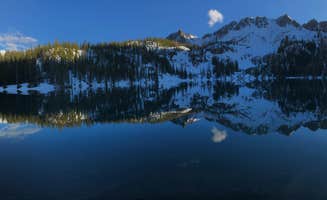
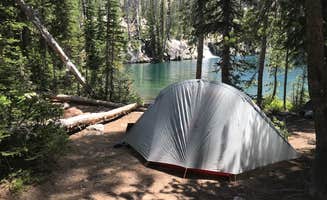
Hiking trails: Multiple campgrounds provide convenient trail access. The Alpine Lake area requires a challenging 5.5-mile hike with 2,000 feet of elevation gain, but rewards visitors with "such beauty and serene, crystal clear waters" at 8,300 feet elevation. Snow may remain into mid-June, making summer and early fall the optimal visiting times.
What campers like
Solitude: Remote camping areas offer escape from crowds. One camper at Decker Flats Dispersed enjoyed that "it was chilly in July but so quiet and peaceful despite every other spot being occupied by an RV." Many dispersed sites allow distance between campers, especially during weekdays.
Stargazing: Clear mountain air and minimal light pollution create ideal stargazing conditions. A visitor to Nip and Tuck Road mentioned "clear views all around with unparalleled astronomy night viewing," making it perfect for night sky photography or casual observation.
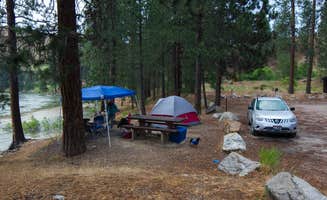
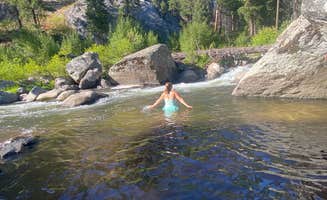
River proximity: Camping alongside water features ranks highly among camper preferences. At Decker Flats, one visitor "found a place to pitch a tent right beside the river" where "the river drowned most of [the traffic noise] out." Many riverside spots provide natural white noise and cooling effects during summer heat.
What you should know
Road conditions: Access to remote sites often requires navigating unpaved roads. At Irish Point Dispersed Camp Ground, campers warn of "about an hour off the highway, 7 miles of which are washboard-bumpy gravel roads along the lake cliffside." Vehicles with higher clearance perform better on these roads.
Seasonal variations: Weather patterns significantly impact camping experiences. One camper at Little Camas Reservoir discovered "in the winter it is not plowed, so you can't access it. Found out the hard way." Spring brings muddy conditions while summer offers more reliable access.
Wildlife encounters: The national forest hosts diverse wildlife including elk, deer, and occasionally predators. Practice proper food storage and waste management. Free camping typically comes with a 14-day limit and minimal amenities, requiring self-sufficiency.
Tips for camping with families
Safety planning: Prepare children for variable conditions and limited services. At Little Camas Reservoir, a visitor mentioned, "there are vault toilets in two locations. No other facilities," making it essential to pack adequate supplies for children's needs.
Site selection: Choose established sites with natural boundaries. A camper at Forest Service Campsite FR0215B noted "large open sites" that provide room for children to explore safely while maintaining distance from other campers.
Animal awareness: Teach children about respecting wildlife and livestock. One camper at Little Camas Reservoir mentioned "grazing cattle nearby," requiring supervision to prevent unwanted interactions between children and free-ranging animals.
Tips from RVers
Size limitations: Many forest roads have tight turns or rough sections limiting larger vehicles. A full-time RVer with a "36 ft Class A with a Cherokee Trailhawk" successfully navigated to Nip and Tuck Road but warned "do not come in from the East on NF-633/Nip and Tuck Road off of Hwy 75" due to a "deep and narrow wash across the road."
Leveling challenges: Prepare for uneven terrain at most dispersed sites. An RVer mentioned finding "a decent site" at Nip and Tuck Road that "sloped a bit from side to side, but we were able to get mostly level" using blocks and leveling systems.
Service availability: Cell coverage varies significantly. At Nip and Tuck Road, "AT&T service was fair with 2-3 bars of LTE and speeds up to about 1.5 MB/s. T-Mobile service was good with 3 bars of 4G/LTE," allowing for emergency communication while maintaining a wilderness experience.












 Traveler


