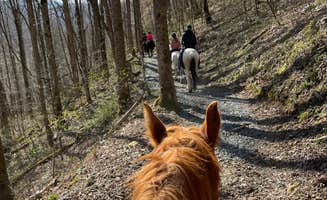
Equestrian trail riding experiences in the Pisgah National Forest offer direct access to over 100 miles of backcountry trails through dense forests and mountain terrain. The Canton region sits at elevations between 2,600-5,000 feet, creating variable weather conditions throughout the riding season. Trail conditions can change rapidly after rainfall, particularly in the spring months when seasonal streams are at their highest.
What to do
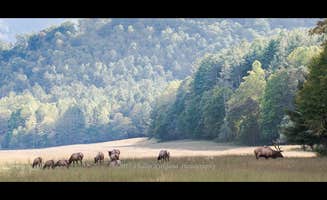
Sunrise mountain viewing: At Cataloochee Campground, riders can access nearby viewpoints for morning wildlife spotting. "We spent 5 nights and watched them early am and afternoons every day. They will get up close-and personal. The rangers keep a watch out, tho, and try to warn u if they are coming too close," notes Jodie K.
Creek fishing access: Most horse camps offer quick access to stocked trout waters. "A wildlife officer came through our camp with a fishnet full of trout to stock the creek. She asked us if we brought our fishing poles," reports Myron C. about his stay at dispersed sites near the horse camps.
Historical exploration: Several trail networks lead to preserved mountain homesteads. "There are historical homesteads, a school, churches and cemetery to take you back in time. Trails by creeks there to hike," describes Jodie K., highlighting additional activities beyond riding.
Waterfall trails: Riders can access multiple cascade trails within a short ride. "Beautiful waterfall (whaleback falls I think?) just a quick 15 minute walk across the river and up the trail," explains Dai C. about trails accessible from camping areas.
What campers like
Solitude and privacy: North Mills River offers quieter alternatives to busier horse camps. "Just a stone's throw from the bustle of Asheville, yet secluded enough to forget it all, this little gem is conveniently located at the entrance to Pisgah National Forest," shares Jonathan N.
Natural cooling: Higher elevation camps provide relief during summer months. "The camp is at 3144 feet in elevation according to my altimiter app so it is nice and cool," notes a camper about temperature advantages.
Stream sounds: Campsites positioned near water create natural ambiance. "As I drove down the winding road I noticed that the twist interns grew narrow the bumps grew frequent... I found the campground jetting off to the left-hand side of the road. It welcomed me with open arms and tall trees casting gorgeous shade," describes Crystal C. about her arrival.
Wildlife interaction: Big Creek Campground provides natural encounters from your campsite. "The campground is very small with only 12 campsites. Each one has a firepit, picnic table, lantern pole, and a very large tent pad... A very nice feature is how close the campsites are to the creek," reports Katrin M.
What you should know
Road limitations: Access roads to horse camps require careful navigation. "A 3-mile stretch of gravel road contains many narrow, blind curves. Though many campsites will accommodate large rigs, motorhomes over 32' and trailers over 25' in length are not recommended due to the access road," warns Kristina about approaches to camping areas.
Water availability varies: Wolf Ford Horse Camp and other horse facilities have inconsistent water supplies. "There was supposed to be access to water, but the only pump in the campground was not working. Fortunately, I brought water with me," shares Myron C.
Bear safety requirements: All horse camps require proper food storage. "This is bear country, so put your food up, along with any scented health and beauty items," cautions Kristina, emphasizing safety protocols.
Seasonal closures affect access: Many secondary roads close during winter. "This campground is frequently effected by weather so planning in advance is a must!!" advises Crystal C. about seasonal considerations.
Tips for camping with families
Swimming options: Creek access points offer natural swimming areas. "The nearby trail system connects riders to extensive routes through Pisgah's dense forests... A very nice feature is how close the campsites are to the creek. It was great for the dogs to cool off. There are also swimming holes nearby," describes Katrin M.
Kid-friendly water areas: Harmon Den Area provides shallow water play spots. "There's an area of the stream where little kids can easily play which is important because I have a three-year-old," shares one camper.
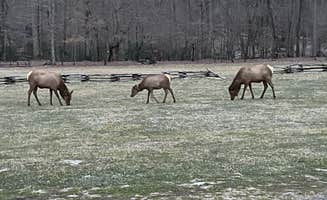
Wildlife viewing schedules: Early mornings and evenings offer best animal sighting opportunities. "If you want to see the elk, you're going to have to be up early. I use to be in the park at 5 AM with night vision gear, I saw some very nice elk," suggests Patrick K.
Educational opportunities: Historic structures provide learning experiences. "Just a short distance after this occurred I found the campground... It was something unlike any other campground I had found in the area completely removed from the comforts of community and distanced intentionally from the creature comforts," notes Crystal C.
Tips from RVers
Dump station access: Cherokee-Great Smokies KOA offers facilities for those needing hookups. "If you are looking to dabble in the Smoky Mountains without losing all cell service, camping at this location is perfect for you!" explains Crystal C., highlighting connectivity options.
Horse trailer parking: Designated areas accommodate various rig sizes. "Sites 3, 5, 7, 8, 9, and 10 are located along the stream. 1, 2, 4 & 6 are across the road from the waterfront sites. Sites 11-15, 17-19 are on the outside of the loop," details Kristina about site arrangements.
Generator limitations: Plan for limited electrical access at horse camps. "No electricity, no problem. A couple of water spigots centrally located and a dish washing station," notes Jodie K. about managing without hookups.
Low clearance challenges: Some access roads require high-clearance vehicles. "The dirt road to get there as well as the pull off for the campsite are rough and a bit dangerous for low/regular cars. It's doable but you should go very slow and watch out for giant holes and ridges," warns Tavi C.



 Guide
Guide


