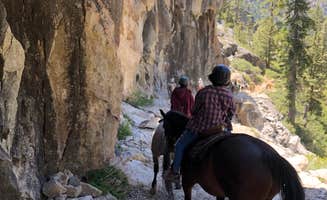
Equestrian camping near Sequoia National Forest offers access to high-elevation trails through diverse landscapes. The area sits at elevations between 5,000-7,600 feet with summer temperatures reaching 80-90°F during the day. Most forest service roads leading to horse-friendly campgrounds remain unpaved and rough, requiring careful navigation with larger trailers.
What to do
Trail riding near volcanic formations: Explore the trails near Fossil Falls dry lake bed where unique basalt rock formations create an otherworldly landscape. "This area is pretty trippy going from volcanic rock and flows to various brush to the dry, beautifully cracked dirt. We landed here and drove thru the FF campground, which we knew was closed but wanted to check it out, and pulled out onto the dry lake bed area to spend the night," shares one camper.
Alpine lake fishing: Access high-elevation lakes at Frog Meadow Campground, located 8.5 miles from Springville. The remote setting requires time to reach but rewards with excellent fishing opportunities. "Not the easiest to get to. But, great for altitude get away. Not winter accessible," notes Tommy B.
Mountain biking: The Keysville South Recreation Site offers extensive single-track trails suitable for various skill levels. "The keyesville classic mountain bike race is held every year in the area! With miles of trails and perfect single track for all age groups and abilities!" writes one reviewer. The area functions as a hub for mountain biking events throughout the summer season.
What campers like
Secluded campsites: At Horse Meadow Campground, campers appreciate the isolation and natural setting. "If you like to be off the grid amidst the trees this is the place for you. We like to camp next to the creek. Fishing is plentiful and the air is great as long as there's no fires near," says Joseph Z.
Stargazing opportunities: The lack of light pollution creates exceptional night sky viewing. "The stargazing is beautiful. There is some limited light pollution emanating from the other side of the foothills, but because you are surrounded by foothills you get some good, dark surroundings to really appreciate the stars," reports one camper at Horse Creek Campground.
Wildlife watching: The forested areas around Sequoia National Forest support diverse wildlife. "We spent four nights at the end of July in this beautiful campground in Sequoia National Forest... There are several hikes which are accessible from the campground," notes Allison A., mentioning the variety of birds and small mammals frequently spotted during morning hours.
What you should know
Limited facilities at remote sites: Most horse campgrounds lack modern conveniences. "No cell or wifi anywhere nearby. The camp host, Wayne, has been hosting the campground for 20 years and does a great job. The campsites are a truly mixed bag. Some are spacious, shady, flat, and along a creek while others seem a bit more attractive to those who are part mountain goat and do not require level surfaces for any reason."
Fire restrictions vary seasonally: Forest officials strictly enforce fire regulations, especially during drought conditions. "The camp ground host was super vigilant and checked regularly to see we had a shovel and a bucket of water on standby. He ran a tight ship. (Kudos to him.) Little water in the stream and hot and dusty."
Security concerns at some locations: Take precautions with valuables, especially at more accessible campgrounds. "We were robbed from this location while out hiking and rafting for the day. Lost thousands of dollars in gear, clothes and personal items. Literally everything was gone, they plucked up the whole tent and took it all, nothing left but some tent stakes once we returned."
Tips for camping with families
Choose sites with creek access: Children enjoy water features during hot summer days. "We did a backpacking trip from Johnsondale Bridge down to Fairview Campground following the Rincon trail in May. It was hot but the views and the quietness was beautiful! Be prepared with lots of water and food."
Bring protection against pests: Certain times of year bring increased insect activity. "Predators: Coyotes, rattlesnakes, meat bees (bring cheap canned meat to set out during the day and they will leave you alone for the most part)," advises a visitor, noting that bats emerge at dusk and help control flying insects.
Pack for temperature fluctuations: Even summer nights become cold at higher elevations. "At 7,600 ft., the nights dropped into the forties. A welcome break from the southern CA heat," mentions a camper, emphasizing the need for layered clothing even during summer months.
Tips from RVers
Level sites are limited: Many forest campgrounds have uneven terrain. "Sites were generally not level as it is situated on the hill down to the lake. Bathrooms were messy and half were out of order due to a maintenance project. The RV Dump station was also unavailable (same reason)."
Bring extra water supplies: Water availability varies seasonally. "The water is potable, but spring fed, so availability is dependent upon whether things have dried up for the season. The nearest supplies are an hour one-way."
Plan for limited connectivity: Cell service is inconsistent throughout the forest. "For those looking to be fully removed from the world, you should know this campsite is RIGHT off the highway, so there is traffic and some headlights if drivers have their brights on."




 Traveler


