Tent camping near Sapelo Island, Georgia offers campers access to unique coastal ecosystems where the Atlantic Ocean meets maritime forests. The Georgia coast features a warm subtropical climate with summer temperatures reaching into the 90s and winter lows rarely dropping below 40°F. Water access is central to most camping experiences in this region, with many campsites requiring either ferry transportation or boat-in access during specific tide windows.
What to do
Beach exploration: At Cabretta Island Pioneer Campground, you're within walking distance of undeveloped beaches perfect for shell collecting and wildlife observation. "The island is 13 miles long so it takes a while to explore everything it has to offer. The beaches are beautiful, the Gullah culture is eye opening, the old mansion is quite nice," notes Savannah C.
Wildlife photography: Cumberland Island provides exceptional opportunities to photograph wild horses, shore birds, and marine life in their natural habitat. "Wild horses running on the beach (and all over the island). Be sure to bring/rent a bike so you can explore all the interesting sites along the islands trails," says Kelly M. about Sea Camp Campground.
Kayaking: Rent kayaks from camp hosts or bring your own to explore the surrounding waterways. "You can also rent kayaks from the hosts and drop them in just down the road," according to Savannah C. from Cabretta Campground. For paddlers, "We paddled from the mainland in St. Mary's to this spot on the island. If you time the tide right, you can ride the Crooked River out relatively quickly," shares Sarah C. about her experience at Brickhill Bluff.
Historical exploration: Visit the ruins and historical structures that dot the islands. "The ruins of an 1800s mansion built by a Carnagie that burned in 1959 is also one of those mysterious places that conjure emotions and kick the imagination in gear," notes Charles D. about Cumberland Island's attractions.
What campers like
Solitude and privacy: Campsites at Stafford Beach Campground offer more seclusion than other areas. "We absolutely adored this campsite. It is more quiet and there are less campers than Sea Camp but you still get amenities like showers, bathrooms, campfires," explains Renee B. The remoteness creates unique experiences: "We only saw one other person on the beach. And wild horses, that's real!"
Facilities at primitive sites: Even at more remote locations, some amenities make camping comfortable. "The campground is breathtaking with nice showers/bathrooms, with a couple covered shelters and a communal pavilion and campfire ring. There are outlets under the pavilion as well as a couple of fixed grills next to it," writes Savannah C. about Cabretta Campground.
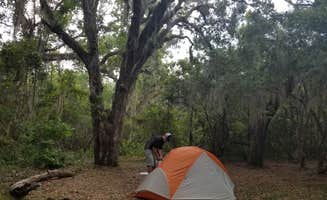
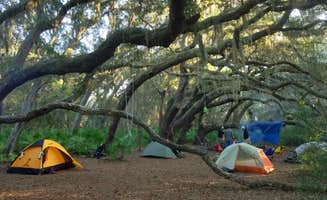
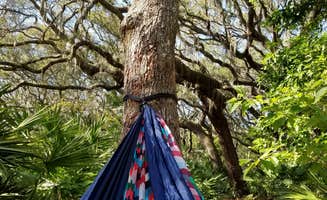
Unique ecosystem immersion: The combination of forest and beach environments provides diverse camping experiences. "Palm trees filling in the canopy of the largest stand of live oaks left in U.S. that all have spanish moss hanging in them like no movie production designer could ever replicate make you feel like you time jumped to a jurassic age," shares Charles D. about Cumberland Island.
Natural beach access: Many sites provide convenient beach access without crowds. "Walking out on beach from tent every morning just to watch the sun rise over the Atlantic ocean while crab boats chug along being part of the scenery as the sun rises, you are first and only person on an 18 mile long beach until around 10 a.m.," notes a Sea Camp camper.
What you should know
Ferry logistics: Access to Brickhill Bluff Wilderness Campsite and other Cumberland Island locations requires advance planning. "Three main cost to account for are the park entry, the ferry, and the daily campsite fee," advises PJ S. You must coordinate ferry schedules with your camping plans well in advance.
Water considerations: Not all sites offer potable water. "Unlike at Sea Camp, it must be treated before drinking (boil, filter, UV, or chemical, etc...)," explains Elliott B. about Stafford Beach. At Yankee Paradise, "there is not any potable water... You will either need to fill your water up from a spigot at Plum Orchard or walk a bit down the parallel trail."
Weather challenges: The Georgia coast experiences high humidity and seasonal bugs. "It was a hot time of year but under the canopy of the live oak trees where the tent sites are located (Sea Camp) was easily 10+ degrees cooler than elsewhere. However, be warned, it was extremely humid," reports David S. Prepare for these conditions with appropriate gear.
Wildlife management: Food storage requires special attention. "Keep all your food and scented items in the racoon proof cages or make sure your coolers/food boxes are locked! Raccoons will pry open just about everything!" warns Adela D., adding that "Raccoons, hogs, and bobcats will make enough noise to keep light sleepers awake all night."
Tips for camping with families
Difficulty levels: Choose campsites based on your family's experience level. Hickory Hill Wilderness Campsite offers a more challenging experience: "We backpacked to this site for our first night on Cumberland Island. It was tough in the heat and humidity," says Renee B., while Sea Camp offers easier access for families with young children.
Transportation aids: Consider bringing carts for gear transport. "You can borrow a cart to take your tent and supplies from the boat to the campsite (Seacamp only - the more distant campsites are hike & carry only). You can also bring your own wagon/cart on the boat," advises David S., which can be crucial when camping with children.
Educational opportunities: Schedule around ranger programs. "The resident volunteer led an info session on armadillos which was educational and fun and really added value to our trip," shares Marian K., noting these programs enhance the family experience on Cumberland Island.
Site selection: For larger family groups, "Some of the sites are big enough for multiple tents" at Sea Camp, while "The sites are large, roomy, and equipped with a picnic table, fire ring, pole for hanging stuff, and a big metal lockable wildlife-proof box," which helps with family organization needs.
Tips from RVers
Limited RV access: Pioneer Campsite at Fort Morris State Historic Site offers one of the few options with electric hookups, fifty-amp hookups, and thirty-amp hookups near the Sapelo Island region. Most island camping locations do not accommodate RVs due to ferry-only access.
Preparation for island stays: If transitioning from RV to tent camping on the islands, pack minimally and efficiently. "Whatever supplies you choose to go camping with, you will need to 'wheel it on' the actual ferry, which likely requires a hard examination of what really is essential versus 'nice-to-have'," suggests Stuart K. about Cumberland Island logistics.
Seasonal considerations: Plan RV visits to mainland campgrounds during shoulder seasons. "Summer months can be extremely humid with persistent insects," while winter offers more comfortable conditions but requires additional layers for nighttime temperature drops into the 40s.
Supply planning: No stores exist on the islands, requiring complete self-sufficiency. "Whatever you actually need for the entire time on this island, you're going to have to bring – because there's ABSOLUTELY no markets or shops to save you if you've forgotten anything," cautions Stuart K. about Cumberland Island trips.






 Legend


