Horse campgrounds near Morrilton, Arkansas offer access to trail systems with varying difficulty levels through national forest terrain. The area sits between the Ozark and Ouachita National Forests at elevations ranging from 300-1,800 feet, creating diverse riding conditions. Summer temperatures often reach 90°F with high humidity, while spring and fall provide milder riding weather in the 60-75°F range.
What to do
Trail riding on Bear Creek system: The Bear Creek Horse Camp provides direct access to interconnected loop trails specifically designed for equestrian use. "The trailhead is located at the rear of the camp. The camp serves as a small primitive camping area for equestrian riders on the network of interconnecting loop trails that comprise the Bear Creek Equestrain Trail system," notes Fred S.
Mountain views from elevation: Mount Nebo State Park Campground offers rides with panoramic vistas at 1,800 feet. "The 'Rim Trail' is just that…a 3 1/2 mile trail running the top rim of the mountain, with long views," writes Dave V. The trails provide options for all skill levels: "Different sections of the Rim Trail range from easy to moderate to strenuous. They are marked."
Swimming and fishing breaks: After dusty trail rides, cool off at Woolly Hollow State Park. "They have paddle boats that you can rent and fishing boats, too," mentions Kathy E. The park offers a designated swimming area for both humans and horses to cool off: "There is a nice swimming area with a shop to order drinks/snacks," reports Alison C.
What campers like
Proximity to multiple trail systems: Equestrian campers appreciate how Moccasin Gap Horse Trail NF Campground connects to extensive trail networks. "Loop of primitive sites along Hwy 7 providing access to Ozark Highlands Trail," notes Stan G., making it a strategic base for riders exploring different routes.
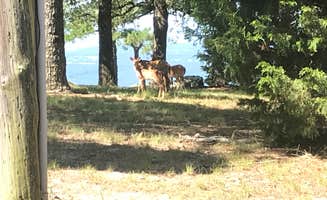
Wildlife encounters: Trail riders frequently spot native wildlife while camping. "We had 5 dogs and 7 people and we were all struggling a tad. The deer will walk up to you and you can pet them awesome park highly recommended," shares Steve S. about his experience at Mount Nebo.
Natural water sources: Equestrian camps typically feature creek access for horses. "A small creek runs along side the camp," Fred S. mentions about Bear Creek Horse Camp. This natural feature provides water for horses after rides without requiring campers to haul additional water supplies.
What you should know
Limited amenities at equestrian sites: Most horse camps offer basic facilities only. "The grounds of the camp do not appear to be maintained, but the sites were clean. There is a very clean vault toilet located at the rear of the camp," Fred S. notes about Bear Creek Horse Camp.
Trail condition warnings: Recent weather impacts trail accessibility. "Some minor erosion on FR772 where small creeks cross the road. FR11 is in good condition at the time of this visit," reports Fred S. regarding access roads to Bear Creek.
Cell service limitations: Communication can be challenging in equestrian camping areas. "No ATT or Verizon service there or in the general area, had to download a map that was essentially a PDF to get around," warns Amy & Stu B. from their experience at Macks Pines, noting that reliable navigation requires preparation.
Tips for camping with families
Start with shorter loop trails: For younger riders, begin with manageable distances. "There are some trails nearby, but the area and trails are really designed for ATVs," notes Amy & Stu B., suggesting these wider paths can be more forgiving for novice riders.
Pack extra water supplies: Drinking water is scarce at most equestrian sites. "No drinking water is available on-site," is commonly reported for horse camps like Bear Creek. Plan to bring 1-2 gallons per person per day plus extra for horses.
Look for dual-activity campgrounds: Camp Robinson Dispersed Site offers both riding and water activities. "Great spot to pitch a tent by lake Conway. Isolated but not too far out," says Rylie R., making it suitable for families who want fishing options between trail rides.
Tips from RVers
Access road considerations: RV access to horse camps requires careful planning. "The road back to it is well maintained and we had good cell reception with AT&T and Spectrum," Julie A. mentions about Camp Robinson, though she cautions: "Dirt roads no electric nice little quiet excluded spot but it's be tough for an RV to get around there."
Larger rig limitations: Many horse camps have restricted access for big rigs. "Grades are up to 18%. The State Park rests up its summit.constructed by the CCC, many of their stonework craftsmanship can be seen in the buildings and trail system," notes Dave V. about Mount Nebo's challenging access road.
Alternative RV-friendly equestrian options: Some private campgrounds offer better RV accommodations for horse owners. "Some sites require a bit of leveling, lots of full hookup and good amount of 50 amp. This campground is geared more to the atv/utv/jeep/offroad vehicle crowd," explains Roscoe's R. about Macks Pines, which accommodates both equestrian and motorized recreation.



 Traveler


