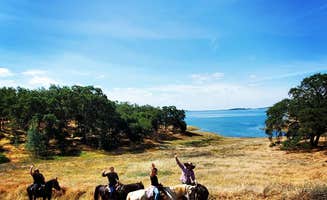
Equestrian camping opportunities near Cool, California extend beyond Ruck-A-Chucky Campground in Auburn State Recreation Area. The region sits in the foothills of the Sierra Nevada mountains at elevations ranging from 1,500 to 3,000 feet, creating a transition zone between valley and alpine ecosystems. Winter camping season from October through April offers mild temperatures compared to higher-elevation alternatives, with daytime averages of 50-65°F and nighttime temperatures rarely dropping below freezing.
What to do
Trail riding connections: The greater Cool area provides access to extensive equestrian trail networks beyond the Western States Trail. At Dru Barner Campground, riders find "lots of wild turkeys, deer, and birds" along with "endless trails around" according to visitor Lily S., making it an excellent base for day rides.
Water activities: Several locations offer alternatives to the American River for cooling off. Folsom Lake State Recreation Area provides "easy trails to take your four legged friend on and of course the beach," notes Cheyenne O., offering more developed swimming areas than riverside options.
Gold panning: The American River watershed maintains a rich mining heritage. At Ruck-A-Chucky, camper Jason A. mentions "if you're lucky and know how to read the river, gold panning is a must!" This historical activity requires minimal equipment and provides an engaging way to connect with the area's past.
What campers like
Privacy between sites: While Ruck-A-Chucky offers separation between its five sites, other nearby campgrounds provide similar seclusion. At Ruck-A-Chucky Campground, camper K.O. describes it as "very quiet and gorgeous. Good spot for families," highlighting the peaceful riverside setting.
River access points: The American River offers multiple entry points beyond those at Ruck-A-Chucky. BRIAN O. notes the Ruck-A-Chucky site was "alongside the American River" and "the sound of the river was calming," providing direct water access without requiring a hike.
Cooler temperatures: The region's moderate elevation creates pleasant conditions during spring and fall. At Dru Barner, camper ProfG999 shares: "I wanted to hide in the forest. Nothing but trees and the wind blowing through them," highlighting the natural air conditioning effect of the forest canopy.
What you should know
Road conditions: Many campgrounds in the area require navigating unpaved roads. At Ruck-A-Chucky, Kevin W. cautions "the 3 mile road down is a bit treacherous (maybe don't take your RV) but makes you feel 'out there'," indicating the access challenges extend beyond just equestrian trailers.
Limited facilities: Most horse-friendly sites offer minimal amenities. Sly Park Recreation Area has "plenty of potable water spigots available throughout the park and plenty of pit toilets," according to camp host Michell C., but lacks shower facilities common to more developed campgrounds.
Seasonal concerns: Weather patterns affect camping conditions significantly. Camper Erin O. at Loon Lake notes that despite the campground being "pretty full," she "shared the lake with only a couple of other people," indicating varying usage patterns throughout the season.
Tips for camping with families
Trail difficulty assessment: Consider age-appropriate hiking options when planning activities. Monique R. describes Sly Park as having "beautiful hikes that are easy for young children. Plenty of trails to choose from," making it suitable for families with younger children.
Campsite selection strategy: Research specific site characteristics when booking. At Hilltop - Sly Park Recreation Area, camper Lloyd C. recommends "Spot 117 is one of the best on Hilltop. Decent amount of shade and large area to park and set up tents," providing guidance on optimal family-friendly locations.
Wildlife awareness: Teach children about appropriate animal interactions. At Dru Barner, Lily S. warns "ants can be an issue if you are careless," highlighting the importance of proper food storage and campsite maintenance with children.
Tips from RVers
RV size limitations: Many horse-friendly campgrounds have restrictive access roads. At Ghost Mountain RV Campground, RVer Craig & Linda L. note it's "about 1.5hr from Sacramento and South Lake Tahoe. Built thick forest of the Sierra mountains. Nice size campsites," offering more accessible alternative for larger rigs.
Dump station availability: Plan waste management carefully when equestrian camping. At Ghost Mountain, camper Craig & Linda L. mention "there is a honey bucket truck that comes around to all camp sites Mon, Wed, and Fridays to dump your gray and black tanks," providing a service not available at more primitive horse camps.
Water access planning: Bring additional water storage for horses at primitive sites. Cheri S. warns at Dru Barner to "bring water as there is none available due to poor quality," requiring self-sufficiency for both human and equine hydration needs.



 Guide
Guide


