Equestrian camping facilities serve as gateways to scenic trail networks near Jamestown, Rhode Island. Located within reasonable driving distance, these specialized campgrounds provide accommodations for both riders and their horses throughout the region. Winter temperatures in this coastal New England area typically range from 20-40°F, while summer brings temperatures between a mild 65-85°F.
What to do
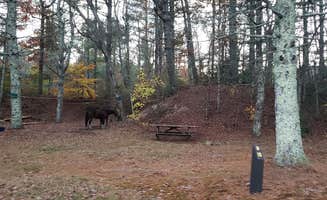
Trail riding access: Three distinct horseback riding loops depart directly from Frog Hollow Horse Camp at Pachaug State Forest, eliminating the need for additional transportation after arrival. "There's space for your camping gear as well as a trailer and horseline," notes Jean C., who visited in late October when approximately "half the sites were occupied."
Fishing opportunities: Multiple stocked ponds exist within a short distance of horse camping areas, providing fishing access between trail rides. At Charge Pond Campground — Myles Standish State Forest, visitors enjoy both land and water recreation. "The pond water was very clear, seeing as they are fed from natural springs under the ponds," reports Kyle C., who adds that the Department of Conservation and Recreation "drives around several times a day in case you have any issues."
Hiking exploration: Beyond equestrian trails, many campgrounds offer hiking paths suitable for days when you're not riding. At Wolf Den Campground — Mashamoquet Brook State Park, campers find "a small walking path and a larger intermediate hiking trail" accessible from the campground, according to a recent visitor who adds that the park has "large open areas for kids and adults to play during day and star gaze at night."
What campers like
Spacious sites: Horse campers appreciate sites with enough room for trailers, camping equipment, and horse containment systems. Sites at most equestrian campgrounds typically measure larger than standard campgrounds to accommodate these needs. "The sites are large and shady but don't have water or electric," notes Stephanie B. about Myles Standish, adding that "the bath houses are clean and accessible."
Privacy between sites: Vegetation buffers between campsites create privacy for horse campers seeking a natural experience. "Our site was wooded and pretty private for a state campground. We had plenty of room and the site had a fire pit and picnic table," reports Kim R., who camped at Charge Pond, where sites are arranged in loops that help maintain separation between camping parties.
Water access: Having water sources near campsites ranks high in importance for equestrians. At The Preserve Club and Residences, which is approximately 23 miles from Jamestown, Chris M. describes it as "simply the best" and "New England's most amenity rich properties," noting it "may be the only place in the world that has such a diverse amount of outdoor offerings."
What you should know
Reservations and access: While some horse campgrounds require advance reservations, others operate on a first-come, first-served basis. Frog Hollow Horse Camp doesn't accept reservations, requiring campers to arrive early during peak seasons to secure a site. Jean C. notes it's "hard to find much information about this equestrian, first come, first serve campground," so planning ahead is essential.
Amenity limitations: Most equestrian campgrounds offer basic amenities focused on horse and rider needs rather than luxury camping experiences. "The campground doesn't have hook ups, but there is a dump station with water and water available around the loops," explains Kim R. about Myles Standish, where some bathhouses may not have hot water during certain periods.
Seasonal considerations: Many horse campgrounds in the region operate seasonally, typically closing during winter months. Normandy Farms Campground operates from "Apr 1 - Nov 30" according to their season information, making it important to verify operating dates when planning equestrian camping trips from Jamestown.
Tips for camping with families
Playground access: Some campgrounds near equestrian facilities include playgrounds for children. "There's a small playground in the middle of the loop," notes Jean C. about Wolf Den Campground, providing an activity option for younger family members between trail rides.
Swimming options: When traveling with children, campgrounds with swimming access provide welcome cooling opportunities during summer months. Though approximately 35 miles from Jamestown, Normandy Farms offers exceptional family amenities. "They had tons of festive activities. They have an indoor and an outdoor pool. The restrooms are clean," reports Liz W., who visited during a Halloween celebration.
Educational opportunities: Several equestrian campgrounds near historic sites offer educational experiences for children. At Myles Standish, Katie D. describes the setting as "beautiful, peaceful, and perfectly isolated" within "a huge state forest," making it ideal for nature education opportunities while maintaining proximity to Plymouth's historic sites.
Tips from RVers
Site dimensions: RV campers should verify site dimensions accommodate both living quarters and horse trailers before arrival. Gary G. notes that at Wolf Den Campground, "Most sites are relatively short level pads, with little or no shade," and recommends "site 33 for the best shade and longer pad."
Electrical access: Many equestrian sites offer limited or no electrical hookups, requiring self-sufficiency. "The sites toward the back of the loop back up toward the woods and give you some more privacy," observes Jean C. about Wolf Den Campground, adding that "Site 20 is the only one with electric" in that particular campground.
Dump station locations: RVers should note the availability of dump stations near equestrian campgrounds. Normandy Farms stands out for comprehensive RV amenities, with Matt T. describing it as "a true RV resort" where "campsites are big and well spaced" and "bathrooms are best of any campground."




 Legend


