Equestrian camping near Marshall, Virginia offers diverse terrain across the Piedmont region's rolling hills and the adjacent Blue Ridge Mountains, with elevations ranging from 600 to 3,500 feet. The area experiences distinct seasons with warm summers averaging 85°F and mild winters, making spring and fall ideal for horseback camping trips. Most horse-friendly campgrounds remain open from April through November, with limited winter availability.
What to Do
Trail riding in Shenandoah National Park: Access mountain trails with designated horse areas within 45 minutes of Marshall. "Beautiful , well maintained... Loved seeing the deer so close and other wildlife. Fire ring with grate was available. Large site size. We had site 23. Highly recommend!" (Terri S., Big Meadows Campground)
Off-road adventures: Combine horseback riding with ATV trails at several multi-use recreation areas. "This was our first time camping here and it will NOT be our last. This Campground had everything I wanted. Shooting range, ATV trails, fishing, hiking and great campsites. We will be back for sure!!" (Ben M., The Cove Campground)
Lake activities: Many equestrian campgrounds offer fishing and swimming opportunities after trail rides. "The lake was very nice and would be the perfect place to cool off on a hot summer day. Next time we come back we will be staying on the same site if possible and definitely bringing some 4 wheelers to check out the miles and miles of trails!" (Andy S., The Cove Campground)
What Campers Like
Spacious sites: Horseback riders appreciate pull-through sites with room for trailers and equipment. "The sites are all pull-through off the roads through the campground. So your camper faces the woods and you feel like you're all alone. Bath houses are clean and well maintained. Our site was very level, but I could see that some others were not so much, so you might want to ask about that." (Roberta K., Big Meadows Campground)
Clean facilities: Quality bathrooms and shower facilities matter after long days of riding. "I'll go again just for the showers... The best review I can give us of the bathrooms. They're with staying again alone. Locking doors, individual stalls. Hot dog. Best camping showers I've ever had." (Yvonne B., Bull Run Regional Park)
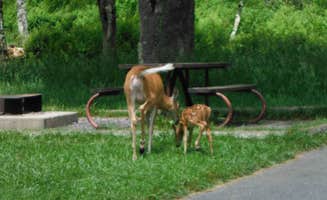
Wildlife viewing: Horse-friendly campgrounds often feature abundant wildlife. "Campground is meticulously clean with daily restroom cleaning and trash pick up. Very small campground store on site but a much larger store at visitor center. Nice amphitheater with interesting ranger programs. Busy traffic in park but nice trails are accessible from campground." (Kim L., Big Meadows Campground)
What You Should Know
Noise considerations: Some campgrounds have shooting ranges or highways nearby that may affect horses. "Camp ground is nice. Check in was a breeze. The only drawback is that it is not quite. There is a shooting range in the park. It is on a flight path for DCA. And, I66 is not that far away." (Drew M., Bull Run Regional Park)
Reservation requirements: Most equestrian sites require advance booking, especially for holiday weekends. "We Camped here over Memorial Day weekend with our pop-up camper. We stayed in camp one which offered electrical hook ups. There are 4 water spigots in camp 1. However all the travel trailers hooked up, which means you either had to make friends or disconnect their water in order to have access." (Christopher K., The Cove Campground)
Limited cell service: Many horse camping areas have minimal connectivity. "We stayed here in August 2021. There was only one other camper there so we had plenty of privacy. We enjoyed the peace and quiet and the lovely mountain views. We also enjoyed access to potable water to fill our tank." (Susan A., Graves Mountain Farm Campground)
Tips for Camping with Families
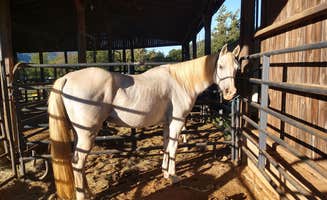
Explore stables and farms: Many equestrian campgrounds offer additional farm activities for kids. "For kids, there is a duck pond, chicken coop, shallow brook, disable farm tractor, and some other stuff to play with/on/in across the street near the lodge. Free range horses (they're penned-in) come back at dusk and head out at dawn -- fun to watch from the campground, especially for kiddos." (Matt, Graves Mountain Farm Campground)
Look for ranger programs: Some parks offer special educational activities. "Our family stayed here in a cabin on a long weekend trip to DC. This campground was full of stuff to do and we didn't even get to do a lot of it. They had a campfire complete with s'mores followed by hayrides. Great family friendly campground." (Bridget H., Bull Run Regional Park)
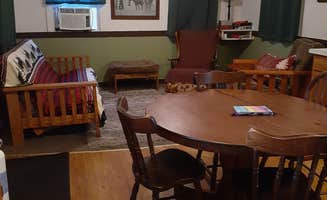
Consider cabin options: For mixed horse/non-horse families, cabins provide comfort while allowing horse access. "We recently stayed at Fort Valley Ranch Campground, near Luray, VA and I can only say good things about our experience and the FVR's management. Our site (site 3) was an easy level pull-through site, making the setup/breakdown very quick and painless." (Jason G., Fort Valley Ranch)
Tips from RVers
Check site length and power: Many equestrian sites accommodate larger rigs but have limited amperage. "In the valley and surrounded by beautiful mountain views it was 80 daytime and ~60 at night. We were in site 12 which was small for our RV (22 ft total pulled by our F-150) but we worked it out. Site 11 and 13 both look nice and a bit more length to them and have electric (15 amp)." (Laure D., Trout Pond Recreation Area)
Road access considerations: Mountain roads can present challenges for large horse trailers. "The drive to the campground (Thorny Bottom Rd. CR 16) was a bit windy but doable. Better to go to Wardensville, WV and down 16 rather than try to cross the mountain near East of Trout Pond." (Laure D., Trout Pond Recreation Area)
Water management: Some equestrian sites have limited water hookups or seasonal restrictions. "Unless you have a powerful vehicle pulling your camper, it would help to release your water supply and fill up when you get to the campground. Locals sell firewood very reasonable just before the campground turn off." (chris J., Trout Pond Recreation Area)




 Guide
Guide


